



HanchorBio Receives FDA Pre-IND Feedback
Supporting Advancement of HCB303, a Next-Generation Trispecific Immunotherapy
FDA feedback supports HanchorBio’s planned U.S. clinical development strategy for HCB303, further validating the Company’s ability to advance differentiated multispecific biologics from its FBDB™ platform
TAIPEI, SHANGHAI, and SAN FRANCISCO — August 12, 2026 — HanchorBio, Inc. (TWSE: 7827), a global clinical-stage biotechnology company developing next-generation immunotherapies for oncology and immune-mediated diseases, today announced that it has received written responses from the U.S. Food and Drug Administration (FDA) following a Type B pre-Investigational New Drug (pre-IND) submission for HCB303, the Company’s next-generation, first-in-class trispecific immunotherapy designed to simultaneously activate innate and adaptive antitumor immunity.
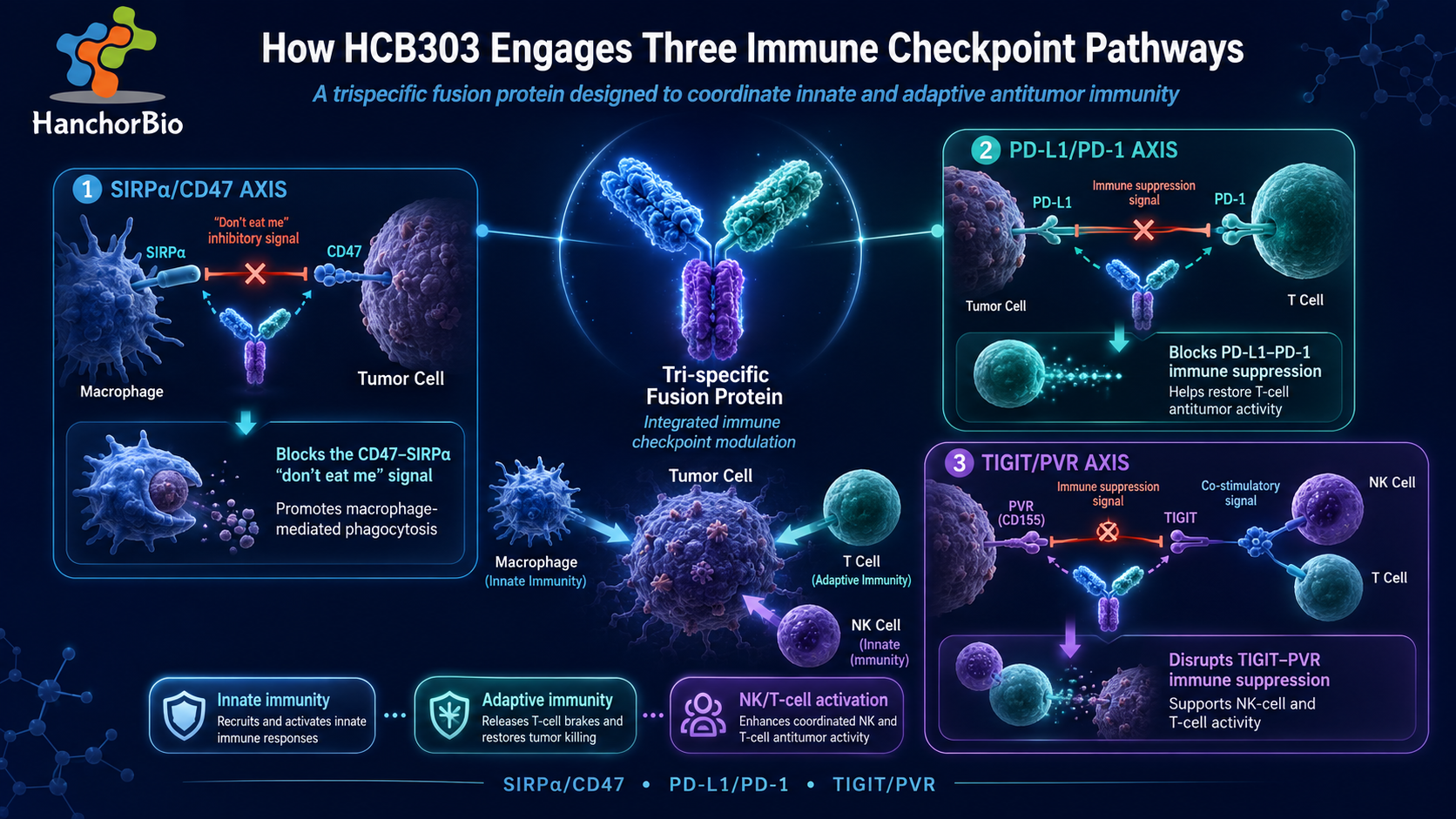
HCB303 is a humanized trispecific fusion protein developed through HanchorBio’s proprietary Fc-Based Designer Biologics (FBDB™) platform. The molecule is designed to modulate three complementary immune pathways—SIRPα/CD47, PD-L1/PD-1, and TIGIT/PVR—within a single therapeutic architecture, thereby coordinating macrophage-mediated phagocytosis, T-cell immunity, and NK-cell antitumor activity.
The FDA’s written responses addressed HanchorBio’s proposed chemistry, manufacturing and controls (CMC), nonclinical, clinical pharmacology, and first-in-human clinical development strategy. The Agency indicated that the Company’s nonclinical studies appear sufficient to support the proposed Phase 1 study and that the proposed approach to determining the starting dose and dose-escalation strategy appears reasonable, subject to review of the complete IND submission.
The FDA also provided guidance regarding clinical safety monitoring, dose-limiting toxicity definitions, pharmacokinetic and pharmacodynamic assessments, and other elements of the planned Phase 1 program. HanchorBio intends to incorporate this feedback into the IND package as it advances HCB303 toward U.S. clinical development.
“HCB303 represents much more than the advancement of another molecule. It demonstrates product-enabling power and scalability of our FBDB™ platform to repeatedly generate differentiated, multifunctional biologics designed around complex human immunobiology,” said Scott Liu, PhD, Founder, Chairman, and CEO of HanchorBio. “With HCB101 already establishing our clinical foundation in innate immune checkpoint biology, HCB301 advancing a trispecific strategy in the clinic, and now HCB303 moving toward IND submission, we are building a pipeline—not a single-product company. Our ambition is to create an engine capable of continuously translating biological insight into globally differentiated medicines.”
A New Trispecific Strategy Across Innate and Adaptive Immunity
Cancer immune resistance rarely results from a single suppressive pathway. HCB303 was therefore engineered to integrate three distinct yet complementary mechanisms into a single molecule.
The SIRPα component is designed to disrupt CD47-mediated “don’t eat me” signaling, enhance macrophage-mediated phagocytosis of tumor cells, and promote de novo activation of T cell clones. PD-L1 blockade is intended to restore adaptive T-cell antitumor activity, while modulation of the TIGIT/PVR axis is designed to relieve immune suppression affecting NK and T cells while preserving CD226-mediated co-stimulatory signaling. By integrating these mechanisms into a single trispecific molecule, HanchorBio aims to coordinate immune activation across macrophages, T cells, and NK cells simultaneously within the tumor microenvironment, potentially achieving a pharmacologic profile distinct from that of administering multiple independent agents.
HCB303 builds upon HanchorBio’s broader strategy of moving beyond single-checkpoint inhibition toward rationally engineered multifunctional immunotherapies capable of addressing the interconnected immune suppression in the tumor microenvironment.
“The next generation of immunotherapy will increasingly be defined not simply by how many targets a molecule contains, but by whether those targets solve a coherent biological problem,” said Alvin Luk, PhD, MBA, President and CMO (Group) & CEO (USA) of HanchorBio. “HCB303 was designed around that principle. By simultaneously addressing myeloid immune suppression, PD-1/PD-L1-mediated adaptive resistance, and the TIGIT/PVR axis, we can influence three major components of antitumor immunity—macrophages, T cells, and NK cells—within one therapeutic architecture. The FDA interaction gives us a clear framework to translate that biology into a disciplined first-in-human development program.”
FDA Feedback Provides a Path Toward First-in-Human Development
HanchorBio’s proposed Phase 1 study is designed to evaluate HCB303 in patients with advanced solid tumors, with tumor types prioritized according to the biological relevance of PD-L1 signaling, TIGIT/PVR-mediated immune suppression, and myeloid-driven immunosuppression.
The proposed clinical program includes once-weekly intravenous administration beginning at 0.03 mg/kg, using a Bayesian Optimal Interval (BOIN) dose-escalation design with a target dose-limiting toxicity rate of 25%. Based on its review of the pre-IND package, the FDA stated that the Company’s nonclinical studies appear sufficient to support the proposed Phase 1 trial. The Agency also indicated that HanchorBio’s approach to determining the starting dose and dose-escalation plan appears reasonable.
The proposed initial study involves a stepwise weekly dose-escalation strategy, while retaining the flexibility to evaluate alternative dose-optimization approaches as human pharmacokinetic and safety data emerge. The clinical development program will incorporate comprehensive PK, pharmacodynamic, receptor occupancy, immune biomarker, immunogenicity, safety, and preliminary antitumor activity assessments to characterize HCB303 and guide selection of recommended dose levels for subsequent clinical development.
From HCB101 to HCB301 to HCB303: Building a Multispecific Immunotherapy Pipeline
HCB303 represents the latest advancement from HanchorBio’s expanding FBDB™ pipeline.
HCB101, the Company’s lead SIRPα-based innate immune checkpoint program, is currently in clinical development across multiple solid tumors and is establishing the translational and clinical foundation for targeting macrophage biology.
HCB301, HanchorBio’s first clinical-stage trispecific program, integrates modulation of SIRPα, PD-L1, and the TGF-β pathway into a single molecule and is currently being evaluated in a Phase 1 clinical study. HCB303 extends this strategy by combining SIRPα and PD-L1 modulation with the TIGIT/PVR immune axis, creating another distinct trispecific architecture designed to address complementary mechanisms of immune resistance.
Together, these programs illustrate HanchorBio’s broader development strategy:
Validated biology → differentiated therapeutic architecture → translational evidence → global clinical development
HanchorBio plans to incorporate the FDA’s recommendations into the final IND-enabling package and advance HCB303 toward U.S. IND submission.
About HCB303
HCB303 is an investigational humanized trispecific fusion protein developed using HanchorBio’s proprietary FBDB™ platform. HCB303 is designed to simultaneously modulate the SIRPα/CD47, PD-L1/PD-1, and TIGIT/PVR immune pathways, thereby engaging complementary components of innate and adaptive antitumor immunity.
The program is designed to enhance macrophage-mediated phagocytosis, restore T-cell antitumor activity, and enhance NK-cell function by addressing multiple mechanisms of immune suppression within a single therapeutic architecture. HCB303 is currently in IND-enabling development and has not been approved by any regulatory authority.
About HanchorBio
HanchorBio (TWSE: 7827) is a global clinical-stage biotechnology company dedicated to developing next-generation immunotherapies for oncology and immune-mediated diseases. The Company’s proprietary Fc-Based Designer Biologics (FBDB™) platform enables the engineering of differentiated multifunctional biologics that simultaneously modulate complementary immune pathways.
HanchorBio’s pipeline includes HCB101, its lead SIRPα-based innate immune checkpoint program; HCB301, a clinical-stage trispecific immunotherapy targeting SIRPα, PD-L1, and TGF-β biology; HCB303, a next-generation trispecific program integrating SIRPα, PD-L1, and TIGIT/PVR biology; and additional programs across oncology and immune-mediated diseases.
With operations spanning Taiwan, China, and the United States, HanchorBio is building an integrated global development organization connecting therapeutic engineering, translational science, clinical development, and regulatory execution. For more information, please visit HanchorBio.com.
Forward-Looking Statements
This press release contains forward-looking statements, including statements regarding the development of HCB303, the timing and potential submission of an IND, initiation and design of future clinical studies, potential therapeutic characteristics and mechanisms of HCB303, development of HanchorBio’s pipeline, and the capabilities and potential of the FBDB™ platform. These statements are based on current expectations and assumptions and involve risks and uncertainties that could cause actual results to differ materially from those described. Regulatory feedback does not constitute approval of an IND or assurance that clinical development will proceed as planned. HanchorBio undertakes no obligation to update forward-looking statements except as required by applicable law.
漢康生技取得美國 FDA Pre-IND 回覆
支持下一代三特異性免疫療法 HCB303 推進開發
FDA 回覆支持漢康生技規劃中的 HCB303 美國臨床開發策略,進一步展現公司 FBDB™ 平台推進差異化多特異性生物藥物的開發能力
【台北、上海、舊金山,2026 年 8 月 12 日】-全球臨床階段生技公司漢康生技(TWSE:7827)今日宣布,公司已就下一代首創(first-in-class)三特異性免疫療法 HCB303 向美國食品藥物管理局(U.S. Food and Drug Administration, FDA)提出 Type B 新藥臨床試驗申請前(pre-Investigational New Drug, pre-IND)資料,並取得 FDA 書面回覆。HCB303 旨在同步啟動先天性與適應性抗腫瘤免疫反應。
HCB303 為透過漢康生技自主開發的FBDB™ 平台所打造之人源化三特異性融合蛋白。此分子設計於單一治療架構中,同時調控三條互補的免疫路徑——SIRPα/CD47、PD-L1/PD-1 及 TIGIT/PVR,以協同巨噬細胞介導的吞噬作用、T 細胞免疫反應及自然殺手細胞(NK cell)的抗腫瘤活性。
FDA 的書面回覆涵蓋漢康生技所提出的化學、製造與管制(CMC)、非臨床研究、臨床藥理,以及首次人體(first-in-human)臨床開發策略。FDA 表示,公司目前規劃的非臨床研究整體而言可望足以支持擬議中的 Phase 1 臨床試驗,而公司所提出的起始劑量決定方式及劑量遞增策略亦屬合理,惟最終仍須以完整 IND 申請資料之審查結果為準。
FDA 同時針對臨床安全性監測、劑量限制毒性(DLT)定義、藥物動力學與藥效學評估,以及 Phase 1 臨床計畫的其他重要項目提供建議。漢康生技預計將相關回覆納入 IND 申請資料中,持續推進 HCB303 在美國的臨床開發。
漢康生技創辦人暨董事長劉世高博士表示:「HCB303 的意義不僅是另一項候選藥物向前推進,更展現 FBDB™ 平台將複雜的人體免疫生物學轉化為差異化、多功能生物藥物的產品化能力與可擴展性。隨著 HCB101 已在先天免疫檢查點生物學領域建立臨床基礎、HCB301 的三特異性策略持續於臨床開發中,如今 HCB303 亦朝 IND 申請邁進,我們所建立的是一條具延展性的產品管線,而非單一產品公司。我們的目標是打造一套能持續將生物學洞見轉化為具全球差異化潛力新藥的研發引擎。」
橫跨先天性與適應性免疫的全新三特異性策略
癌症免疫抗性通常並非源自單一免疫抑制路徑,因此 HCB303 的設計核心,即是在單一分子中整合三項彼此不同但高度互補的作用機制。
其中,SIRPα 組件旨在阻斷 CD47 所介導的「別吃我」訊號,增強巨噬細胞對腫瘤細胞的吞噬作用,並促進新生 T 細胞株的活化;PD-L1 阻斷機制則旨在恢復適應性 T 細胞的抗腫瘤活性;對 TIGIT/PVR 軸的調控,則設計用以解除影響 NK 細胞與 T 細胞的免疫抑制,同時保留 CD226 所介導的共刺激訊號。
透過將上述三種機制整合於單一三特異性分子中,漢康生技期望能在腫瘤微環境內同步協調巨噬細胞、T 細胞與 NK 細胞的免疫活化,並有機會形成不同於多種獨立藥物合併給藥的藥理特性。
HCB303 延續漢康生技整體研發策略,由單一免疫檢查點抑制進一步邁向經理性設計的多功能免疫療法,以因應腫瘤微環境中彼此交織的多重免疫抑制機制。
漢康生技集團總裁暨醫療長、美國子公司執行長陸英明博士表示:「下一代免疫療法的關鍵,將不只是單一分子包含多少個靶點,更重要的是這些靶點能否共同解決一個具一致生物學邏輯的問題。HCB303 正是基於這項理念進行設計。透過同步處理髓系免疫抑制、PD-1/PD-L1 所介導的適應性免疫抗性,以及 TIGIT/PVR 路徑,我們得以在單一治療架構中,同時影響抗腫瘤免疫的三大重要組成——巨噬細胞、T 細胞及 NK 細胞。此次與 FDA 的溝通,為我們如何將這套生物學機制轉化為嚴謹的首次人體臨床開發計畫提供了清楚的框架。」
FDA 回覆為首次人體臨床開發提供推進方向
漢康生技所規劃的 Phase 1 臨床試驗,擬針對晚期實體腫瘤患者評估 HCB303,並將依據 PD-L1 訊號、TIGIT/PVR 所介導的免疫抑制,以及髓系細胞驅動之免疫抑制與不同腫瘤類型間的生物學相關性,決定優先納入的腫瘤類別。
擬議中的臨床計畫採每週一次靜脈注射,起始劑量為 0.03 mg/kg,並採用 Bayesian Optimal Interval(BOIN)劑量遞增設計,目標劑量限制毒性(DLT)發生率設定為 25%。根據 FDA 對 pre-IND 資料的審閱,FDA 表示,公司目前的非臨床研究整體而言可望足以支持擬議中的 Phase 1 試驗,且漢康生技所提出的起始劑量決定方式與劑量遞增計畫亦屬合理。
初步試驗規劃採取逐步、每週給藥的劑量遞增策略,同時保留彈性,可隨著人體藥物動力學及安全性資料累積,進一步評估其他劑量最佳化方案。
整體臨床開發計畫預計納入完整的藥物動力學(PK)、藥效學、受體佔有率(RO)、免疫生物標記、免疫原性、安全性,以及初步抗腫瘤活性評估,以全面描繪 HCB303 的臨床特性,並作為後續臨床開發建議劑量選擇的依據。
從 HCB101、HCB301 到 HCB303:建立多特異性免疫療法產品管線
HCB303 為漢康生技持續擴展 FBDB™ 產品管線的最新進展。
HCB101 為公司核心 SIRPα 先天免疫檢查點產品,目前已於多種實體腫瘤展開臨床開發,並持續建立以巨噬細胞生物學為治療核心的轉譯與臨床基礎。
HCB301 則為漢康生技首項進入臨床階段的三特異性產品,於單一分子中整合 SIRPα、PD-L1 及 TGF-β 路徑的調控,目前正進行 Phase 1 臨床研究。
HCB303 則進一步延伸此一策略,在 SIRPα 與 PD-L1 調控基礎上加入 TIGIT/PVR 免疫路徑,形成另一項具差異化的三特異性分子架構,旨在處理相互互補的多種免疫抗性機制。
綜合而言,這些產品展現漢康生技整體研發策略:
經驗證的生物學機制 → 差異化治療架構 → 轉譯證據 → 全球臨床開發
漢康生技計畫將 FDA 建議納入最終 IND-enabling 資料,並持續推進 HCB303 朝美國 IND 申請邁進。
關於 HCB303
HCB303 為漢康生技透過自主 FBDB™ 平台開發的研究中新藥,屬人源化三特異性融合蛋白。HCB303 旨在同步調控 SIRPα/CD47、PD-L1/PD-1 及 TIGIT/PVR 三條免疫路徑,以同時啟動先天性與適應性抗腫瘤免疫中的互補機制。
該產品旨在藉由於單一治療架構中處理多項免疫抑制機制,增強巨噬細胞介導的吞噬作用、恢復 T 細胞抗腫瘤活性,並增強 NK 細胞功能。HCB303 目前處於 IND-enabling 開發階段,尚未獲任何監管機構核准。
關於漢康生技:
漢康生技(HanchorBio,TWSE:7827)布局台北、上海與舊金山灣區,是一家全球臨床階段生技公司,專注於腫瘤免疫與免疫相關疾病創新療法的開發。公司專有的FBDB多功能融合蛋白技術平台(FBDB™)平台,可設計具多元靶向模式的多功能生物藥,同時活化先天性與適應性免疫路徑,以突破現有免疫療法的限制。
漢康生技持續推進多項創新生物藥產品,透過差異化分子設計、轉譯開發策略及可規模化的 CMC 能力,滿足尚未被充分滿足的重大醫療需求。
聲明:
本新聞稿及同時發佈之相關資訊內含有預測性敘述;其內容乃根據既有之風險及可能的不確定性進行判斷及預測,包括:市場因素與其他非漢康-KY(以下簡稱本公司)所能掌控之原因。這些預測性敘述是基於現況的預測和評估,除非基於法律的要求,本公司不負日後更新之責。