



HanchorBio Advances HCB101 Macrophage-Directed Immunotherapy Strategy with First Patient Dosed in Global HNSCC Study
Global expansion builds on durable HCB101 monotherapy activity and encouraging 50% ORR
in Taiwan IIT HNSCC observations supporting macrophage-directed immunotherapy development
TAIPEI, SHANGHAI, and SAN FRANCISCO — August 17, 2026 — HanchorBio, Inc. (TWSE: 7827), a global clinical-stage biotechnology company developing next-generation immunotherapies for oncology and immune-mediated diseases, today announced that the first patient has been dosed in Cohort 6b of its global Phase 1b/2a HCB101-201 study (NCT06771622).
Cohort 6b is evaluating HCB101, an AI-assisted, structure-guided SIRPα-IgG4 Fc fusion protein developed using HanchorBio’s FBDB™ platform, in combination with pembrolizumab and cetuximab in first-line recurrent or metastatic head and neck squamous cell carcinoma (HNSCC).
The global HNSCC expansion builds on a sequence of clinical observations—from durable HCB101 monotherapy activity to encouraging combination data from an investigator-initiated trial (IIT)—that provided the rationale for prospectively evaluating macrophage-directed immunotherapy in HNSCC, a tumor setting in which myeloid biology may contribute to immune resistance.
The first patient was enrolled in Cohort 6b, led by a principal investigator who had previously conducted an investigator-initiated HNSCC study. Encouraging clinical observations from that study helped support HanchorBio’s decision to advance HCB101 into dedicated global HNSCC combination cohorts.
“We are not developing HCB101 simply as another CD47-targeting molecule. We engineered HCB101 around a fundamental biological question: can we make macrophage checkpoint biology clinically actionable and extend cancer immunotherapy beyond predominantly T-cell-directed approaches?” said Scott Liu, PhD, Founder, Chairman, and CEO of HanchorBio. “HNSCC is an important testing ground for this hypothesis. Having observed durable monotherapy activity and encouraging preliminary combination data, we are now translating these clinical observations into prospective global development to build a truly differentiated oncology platform. For us, this is how human clinical evidence begins to validate not only a molecule, but the biology behind a platform.
Engineering Innate Immune Checkpoint Blockade
HCB101 is designed to block the SIRPα-CD47 innate immune checkpoint, a key mechanism through which cancer cells can evade macrophage-mediated phagocytosis. Developed using HanchorBio’s proprietary FBDB™ platform, HCB101 incorporates structure-guided molecular design features intended to reduce unnecessary red blood cell interactions while maintaining potent target engagement, with the goal of enabling sustained innate immune checkpoint blockade and rational combination with established cancer therapies.
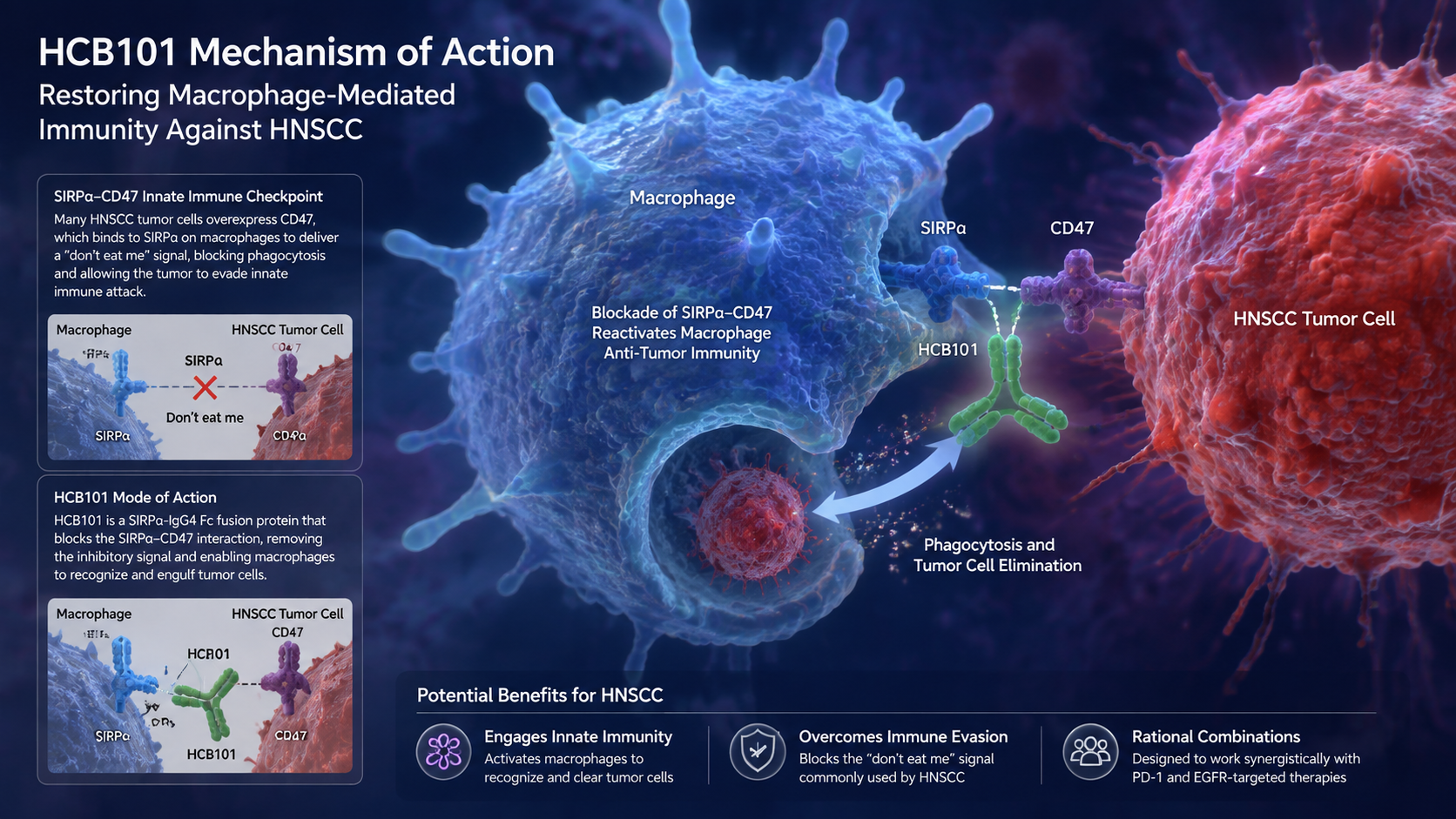
In first-in-human clinical testing, HCB101 has demonstrated dose-proportional pharmacokinetics and sustained CD47 receptor occupancy, including greater than 90% receptor occupancy at clinically relevant dose levels.
These pharmacologic findings have been accompanied by early clinical activity in HNSCC:
- Durable monotherapy activity: In Phase 1a dose escalation, an HNSCC patient treated with HCB101 monotherapy achieved a confirmed partial response with approximately 42% tumor reduction and remained on treatment for more than 80 weeks at the updated data cutoff.
- Supportive investigator-initiated clinical observations: In a low-dose (1.28 mg/kg) HNSCC cohort from an investigator-initiated study, 4 response-evaluable HNSCC patients demonstrated a 50% confirmed objective response rate (2/4) and 100% disease control at first assessment (4/4). Tumor reduction reached up to 68%, including one response that deepened from a partial response to a complete response.
The investigator-initiated dataset is small and preliminary and should be interpreted cautiously. Together with the durable monotherapy response, however, these observations provided important clinical support for prospective evaluation of HCB101 in HNSCC within the global HCB101-201 study.
“What makes today’s milestone important is not simply the first patient dosed, but the sequence of evidence that brought us here,” said Alvin Luk, Ph.D., M.B.A., C.C.R.A., President and Chief Medical Officer (Group) and CEO (U.S.A.) of HanchorBio. “We engineered HCB101 to address limitations that have challenged the CD47/SIRPα field, demonstrated sustained target engagement in patients, observed durable monotherapy activity in HNSCC, and then saw encouraging supportive activity from the Taiwan IIT. We are now taking that biological hypothesis into prospective global testing.”
Triple-Mechanism Strategy in HNSCC
Recurrent or metastatic HNSCC remains an area of substantial unmet medical need despite advances with PD-1-based therapy. The tumor microenvironment in HNSCC involves complex interactions among tumor cells, macrophages, myeloid populations, and adaptive immune cells that may contribute to immune resistance.
Cohort 6b evaluates a rational combination designed to engage complementary components of antitumor immunity:
- HCB101: Blocks the SIRPα-CD47 innate immune checkpoint to enhance macrophage-mediated antitumor activity.
- Pembrolizumab: Targets the PD-1 adaptive immune checkpoint to restore T-cell activity.
- Cetuximab: Targets EGFR-expressing tumor cells while providing an antibody-based backbone capable of engaging innate immune effector mechanisms.
“Cancer immunotherapy has been shaped largely by T-cell biology. We believe macrophages represent another important layer of antitumor immunity. By combining macrophage-directed innate immunity with PD-1 and EGFR-directed therapy, Cohort 6b allows us to test whether engaging multiple dimensions of immunity can improve outcomes in HNSCC, where substantial unmet need remains,” said Dr. Luk.
From Investigator-Generated Insight to Global Development
The HCB101 HNSCC program represents the progression of an investigator-generated clinical observation into prospective global development. Early clinical observations from the investigator-initiated study helped support HanchorBio’s decision to advance HCB101 into dedicated global HNSCC combination cohorts.
This progression highlights how clinical investigators can contribute not only to the execution of global trials, but also to the scientific and clinical insights that shape global drug development strategies.
“The value of early clinical research is not only the data it generates, but the scientific questions it allows us to ask next,” said the principal investigator. “The clinical activity observed in our HNSCC study encouraged us to further investigate macrophage-directed treatment in this disease. We are pleased that patients are now contributing directly to the global clinical evaluation of this strategy.”
Expanding the HCB101 Development Strategy
HCB101-201 is a global, multicenter, open-label Phase 1b/2a study evaluating HCB101 in rational combinations across prioritized solid tumors. In addition to HNSCC, HanchorBio is evaluating HCB101-based combinations in gastric cancer, colorectal cancer, and triple-negative breast cancer.
The HNSCC program expands HCB101 development beyond gastrointestinal malignancies and tests whether its therapeutic biology can translate into additional myeloid-rich and immunotherapy-relevant tumor settings.
“A platform is not validated because it can generate many molecules. It is validated when a biological idea repeatedly generates clinically meaningful hypotheses that can be tested across diseases, mechanisms and combinations,” Dr. Liu added. “HCB101 is our clinical anchor. What we are building around it is a broader understanding of how macrophage biology can become part of the next generation of cancer immunotherapy.”
About HCB101
HCB101 is an investigational engineered SIRPα–IgG4 Fc fusion protein developed using HanchorBio’s proprietary FBDB™ platform. HCB101 blocks CD47–SIRPα signaling and is designed to enhance macrophage-mediated antitumor immunity. It is being evaluated as monotherapy (NCT05892718) and in combinations (NCT06771622) across solid and hematologic malignancies. HCB101 has received U.S. FDA Orphan Drug Designation for gastric cancer.
About HanchorBio
Based in Taipei, Shanghai, and the San Francisco Bay Area, HanchorBio (TWSE: 7827) is a global clinical-stage biotechnology company focused on immuno-oncology and immune-mediated diseases. The Company’s proprietary Fc-based designer biologics (FBDB™) platform enables the engineering of multifunctional biologics with diverse targeting modalities designed to activate innate and adaptive immune pathways and address limitations of current immunotherapies.
HanchorBio is advancing a portfolio of innovative biologics designed to address significant unmet medical needs through differentiated molecular configurations, translational development strategies, and scalable CMC capabilities. For more information, please visit: https://www.HanchorBio.com
Reimagining Immunotherapy for Patients Worldwide.
Forward-Looking Statements
This press release contains forward-looking statements, including statements regarding the clinical development of HCB101; the design, conduct, timing, and potential outcomes of the HCB101-201 study and its HNSCC cohorts; the potential therapeutic characteristics and mechanisms of action, and combination strategies of HCB101; the potential role of macrophage-directed immunotherapy in HNSCC and other tumor settings; the development of HanchorBio’s pipeline; and the capabilities and potential of the FBDB™ platform. These statements are based on HanchorBio’s current expectations and assumptions and involve risks and uncertainties that could cause actual results to differ materially from those described. Early clinical and investigator-initiated study data may not be predictive of results from larger or later-stage clinical studies. There can be no assurance that ongoing or planned clinical studies will proceed as expected or that HCB101 will demonstrate safety, efficacy, or obtain regulatory approval. HanchorBio undertakes no obligation to update forward-looking statements except as required by applicable law.
漢康生技推進巨噬細胞導向免疫治療策略
HCB101 全球頭頸癌研究完成首位病人給藥
HCB101 單藥治療展現持久臨床活性,臺灣研究者發起的臨床研究亦觀察到 50% ORR,支持巨噬細胞導向免疫治療進一步推進全球臨床開發
【台北、上海、舊金山,2026 年 8 月 17 日】-全球臨床階段生技公司漢康生技(TWSE:7827)致力於開發應用於腫瘤及免疫相關疾病的次世代免疫療法,今日宣布,其全球 1b/2a 期 HCB101-201 臨床試驗(NCT06771622)第 6b 研究組別(Cohort 6b)已完成首位病人給藥。
其評估 HCB101 與單株抗體標靶藥物pembrolizumab 及 cetuximab 聯合治療,用於復發性或轉移性頭頸部鱗狀細胞癌(HNSCC)一線治療。HCB101 為一款運用 AI 輔助與結構導向設計,並透過漢康生技專有 FBDB™ 平台開發的 SIRPα-IgG4 Fc 融合蛋白。
此次頭頸癌全球臨床拓展,建立在一系列臨床觀察基礎之上,包括 HCB101 單藥治療展現持久臨床活性,以及研究者發起的臨床研究中所觀察到令人鼓舞的聯合治療數據。這些結果進一步支持於頭頸癌中評估透過活化巨噬細胞抗癌的免疫治療策略;巨噬細胞等髓系免疫細胞可能與腫瘤對免疫治療產生抗性有關。
首位病人已納入第 6b 研究組別,其中主要研究者先前亦曾主持頭頸癌研究者發起的臨床研究,其中令人鼓舞的臨床觀察結果,進一步支持漢康生技將 HCB101 推進至專門的全球頭頸癌聯合治療研究組別。
漢康生技創辦人、董事長暨執行長劉世高博士表示:「我們開發 HCB101,並非只是為了打造另一款靶向 CD47 的分子。我們從一個根本性的生物學問題出發進行 HCB101 的工程設計:我們能否讓巨噬細胞檢查點的生物學真正轉化為臨床可行的治療策略,並讓癌症免疫治療突破目前主要由 T 細胞導向治療所主導的框架?HNSCC 是驗證這項假設的重要臨床場域。在觀察到持久的單藥治療活性以及令人鼓舞的初步聯合治療數據後,我們正將這些臨床觀察推進至前瞻性的全球臨床開發,進一步建立真正具差異化的腫瘤治療平台。對我們而言,這正是人體臨床證據開始驗證的不只是單一分子,更是整個平台背後生物學基礎的過程。」
工程化先天免疫檢查點阻斷策略
HCB101 旨在阻斷 SIRPα-CD47 先天免疫檢查點,此為癌細胞逃避巨噬細胞吞噬作用的重要機制之一。HCB101 運用漢康生技專有的 FBDB™ 平台開發,並導入結構導向的分子設計,以降低不必要的紅血球交互作用,同時維持強效的靶點結合能力,目標在於實現持續性的先天免疫檢查點阻斷,並可合理搭配現有癌症治療方式進行聯合治療。
在首次人體臨床試驗中,HCB101 的臨床數據顯示,隨著給藥劑量增加,病人體內的藥物暴露量亦呈穩定增加,並展現持續性的 CD47 受體佔有率;在具臨床意義的劑量水準下,CD47 受體佔有率可超過 90%。
上述藥理學結果亦伴隨頭頸癌的早期臨床活性:
- 持久的單藥治療活性:在 1a 期劑量遞增試驗中,一名接受 HCB101 單藥治療的 HNSCC 病人達到經確認的部分緩解(PR),腫瘤縮小約 42%;截至更新後的數據截止日,該病人持續接受治療已超過 80 週。
- 研究者發起的臨床研究提供支持性觀察:採用低劑量 1.28 mg/kg 的 HNSCC 隊列中,4 名可評估療效的 HNSCC 病人,其經確認的客觀緩解率(ORR)為 50%(2/4),首次療效評估時的疾病控制率(DCR)達 100%(4/4)。腫瘤最大縮小幅度達 68%,其中一名病人的療效由部分緩解進一步深化至完全緩解(CR)。
此研究者發起的臨床研究數據樣本數仍小且屬初步結果,應審慎解讀。然而,結合 HCB101 單藥治療所觀察到的持久緩解,這些結果為 HCB101 在全球 HCB101-201 試驗中進一步展開頭頸癌前瞻性評估提供了重要的臨床支持。
漢康生技集團總裁暨醫療長、美國子公司執行長陸英明博士表示:「今天這項里程碑的重要性,不只是完成首位病人給藥,而是促使我們走到這一步的一連串證據。我們透過工程設計 HCB101,以解決過去 CD47/SIRPα 領域面臨的部分限制;我們在病人體內證實了持續性的靶點結合能力,也在 HNSCC 中觀察到持久的單藥治療活性,隨後又從臺灣研究者發起的臨床研究中觀察到令人鼓舞的臨床活性。現在,我們正將這項生物學假設推進至前瞻性的全球臨床驗證。」
頭頸癌三重作用機制策略
儘管 PD-1 為基礎的治療已取得進展,復發性或轉移性頭頸癌仍存在顯著的未滿足醫療需求。頭頸癌的腫瘤微環境涉及腫瘤細胞、巨噬細胞、其他髓系免疫細胞與適應性免疫細胞之間複雜的交互作用,而這些因素可能與免疫治療抗性有關。
第 6b 研究組別評估一項旨在調動不同抗腫瘤免疫機制的聯合治療方案:
- HCB101:阻斷 SIRPα-CD47 先天免疫檢查點,以增強巨噬細胞介導的抗腫瘤活性。
- Pembrolizumab:靶向 PD-1 適應性免疫檢查點,以恢復 T 細胞活性。
- Cetuximab:靶向表現 EGFR 的腫瘤細胞,同時作為抗體治療骨幹,啟動先天免疫效應機制。
陸英明博士進一步表示:「癌症免疫治療的發展長期以來主要由 T 細胞生物學所驅動。我們相信,巨噬細胞代表抗腫瘤免疫的另一個重要層面。透過結合巨噬細胞導向的先天免疫、PD-1 以及 EGFR 靶向治療,第 6b 隊列讓我們能夠進一步驗證,透過結合巨噬細胞導向的先天免疫、PD-1 及 EGFR 靶向治療,第 6b 研究組別將進一步驗證,同時調動多層次免疫反應是否能改善 HNSCC 的治療結果,目前此疾病仍存在顯著的未滿足醫療需求。」
從研究者臨床洞察走向全球開發
HCB101 頭頸癌開發計畫,展現研究者所產生的早期臨床觀察如何進一步推進至前瞻性的全球臨床開發。研究者發起的臨床研究所累積的早期觀察結果,支持漢康生技進一步將 HCB101 推進至專門的全球頭頸癌聯合治療研究組別。
此一進程凸顯臨床研究者不僅能參與全球臨床試驗的執行,其所產生的科學與臨床洞察,也能進一步影響全球新藥開發策略。
早期臨床研究的價值,不僅在於它所產生的數據,更在於這些數據得以提出下一個值得探討的科學問題。在頭頸癌研究中觀察到的臨床活性,促使進一步探索巨噬細胞導向治療在此疾病中的應用。
擴展 HCB101 臨床開發策略
HCB101-201 是一項全球、多中心、開放標籤的 1b/2a 期臨床試驗,旨在評估 HCB101 於優先開發實體腫瘤中的多項合理聯合治療方案。除頭頸癌外,漢康生技目前亦正在評估以 HCB101 為基礎的聯合療法,應用於胃癌、結直腸癌及三陰性乳癌。
頭頸癌計畫將 HCB101 的臨床開發由胃腸道腫瘤進一步拓展至其他癌別,並驗證其治療生物學能否延伸至更多髓系細胞豐富且與免疫治療高度相關的腫瘤環境。
劉世高博士補充表示:「一個平台的價值,並不是因為它能夠產生許多不同分子就獲得驗證;真正的驗證,在於一項生物學理念能否持續產生具有臨床意義、並可跨疾病、跨機制及跨聯合治療進行驗證的假設。HCB101 是我們的臨床核心產品,而我們正以此為基礎,建立更完整的巨噬細胞生物學理解,讓巨噬細胞有機會成為下一代癌症免疫治療的重要組成部分。」
關於 HCB101
HCB101 是一款運用漢康生技專有 FBDB™ 平台開發的研究中工程化 SIRPα–IgG4 Fc 融合蛋白。HCB101 可阻斷 CD47–SIRPα 訊號傳導,旨在增強巨噬細胞介導的抗腫瘤免疫反應。目前 HCB101 正於實體瘤及血液腫瘤中進行單藥治療(NCT05892718)及聯合治療(NCT06771622)評估。HCB101 已獲美國 FDA 授予胃癌孤兒藥資格認定(Orphan Drug Designation)。
關於漢康生技
漢康生技(HanchorBio,TWSE:7827)據點遍及台北、上海及舊金山灣區,是一家專注於腫瘤免疫及免疫相關疾病的全球臨床階段生技公司。公司專有的FBDB™(以Fc為骨架、具特殊構型的多功能腫瘤免疫生物製劑)平台,可透過多樣化靶向模式設計具多重功能的生物製劑,以活化先天性及適應性免疫路徑,並解決現有免疫治療的部分限制。
漢康生技正推進一系列創新生物製劑產品組合,透過差異化的分子設計、轉譯開發策略,以及具規模化能力的 CMC 技術,致力於解決重大的未滿足醫療需求。
前瞻性聲明
本新聞稿包含前瞻性陳述,包括有關 HCB101 的臨床開發;HCB101-201 試驗及其頭頸部鱗狀細胞癌(HNSCC)研究組別的設計、執行、時程與潛在結果;HCB101 潛在的治療特性、作用機制及聯合治療策略;巨噬細胞導向免疫治療於 HNSCC 及其他腫瘤類型中的潛在應用;漢康生技產品管線的開發;以及 FBDB™ 平台的能力與潛力等相關陳述。上述陳述係基於漢康生技目前的預期與假設,並涉及可能導致實際結果與所述內容存在重大差異的風險與不確定性。
早期臨床數據及研究者發起的臨床研究數據,未必能預測較大規模或較後期臨床試驗的結果。公司亦無法保證目前進行中或規劃中的臨床試驗將如預期推進,或 HCB101 最終能證實其安全性與有效性,或取得監管機構核准。除適用法律另有規定外,漢康生技無義務更新任何前瞻性陳述。