



HanchorBio Expands Next-Generation Immunotherapy Strategy by Integrating Immune Education and Macrophage Activation
Exploring vaccine-based immune activation collaborations to combine tumor-specific immune recognition with innate immune activation for cancer and immune-mediated diseases
TAIPEI, SHANGHAI, and SAN FRANCISCO — August 20, 2026 — HanchorBio, Inc. (TWSE: 7827), a global clinical-stage biotechnology company developing next-generation immunotherapies, today announced the expansion of its immunotherapy strategy to explore vaccine-based immune activation approaches through strategic collaborations in cancer and immune-mediated diseases.
Recent clinical advances in therapeutic cancer vaccines have highlighted a new era of immunotherapy — one in which the immune system can be precisely educated to recognize disease-specific targets and generate tumor-directed immune responses. These breakthroughs demonstrate the potential of antigen-specific immune activation to complement existing immunotherapy approaches and further transform cancer treatment.
However, generating tumor-specific immune responses represents only one critical step in achieving durable anti-tumor immunity. Many solid tumors develop complex immune resistance mechanisms within the tumor microenvironment, including suppression of innate immune function that can limit immune activation, antigen processing, and effective tumor clearance.
HanchorBio believes the next generation of immunotherapy will require coordinated activation of multiple immune mechanisms—integrating immune education, immune activation, and immune execution.
HanchorBio’s proprietary FBDB™ (Fc-Based Designer Biologics) platform and lead oncology program, HCB101, are designed to address a complementary immune barrier through macrophage-directed immunotherapy. HCB101 is an engineered SIRPα-IgG4 Fc fusion protein designed to block the CD47-SIRPα innate immune checkpoint and enhance macrophage-mediated anti-tumor activity.
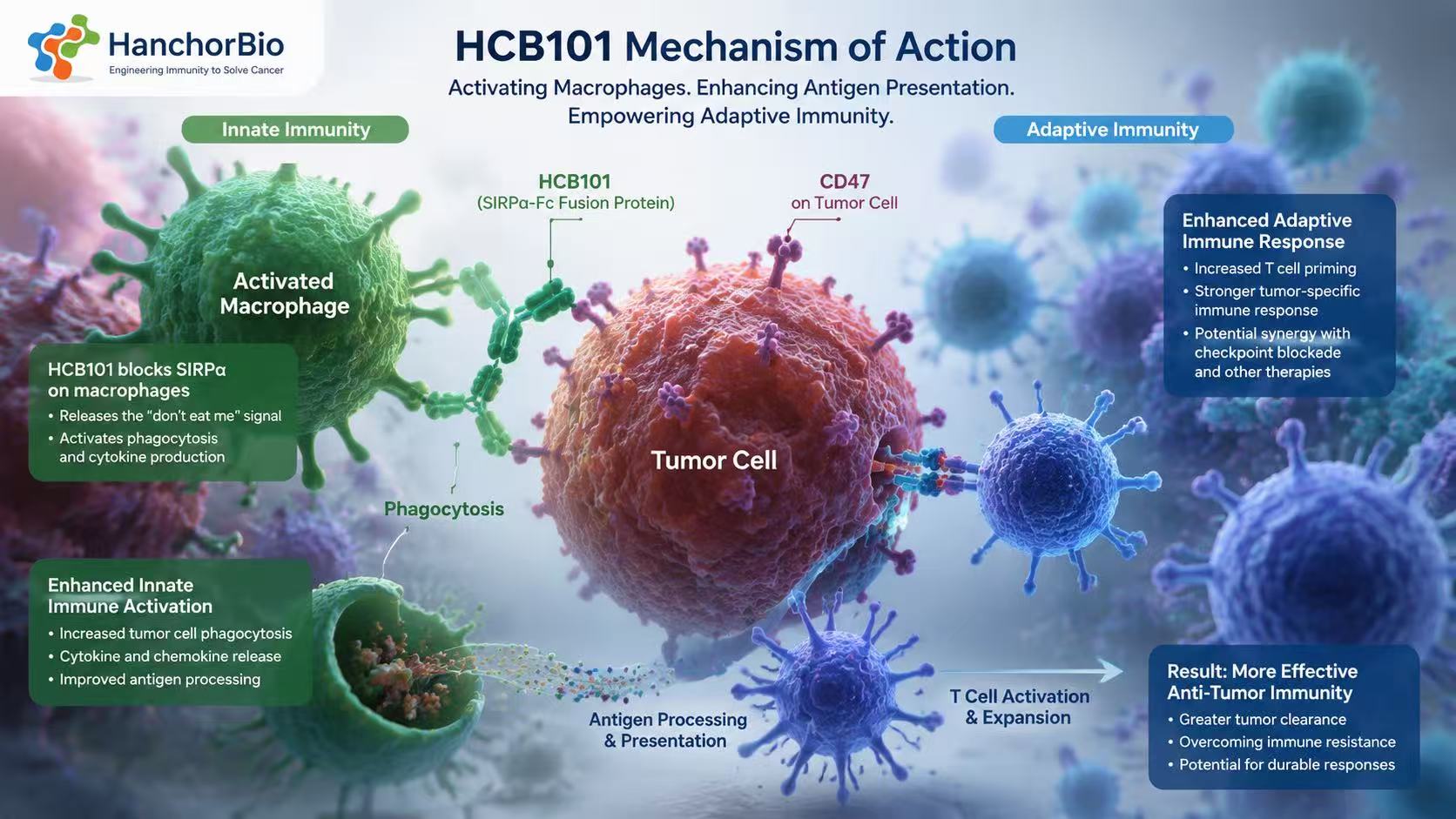
By activating macrophage function, HCB101 has the potential to complement vaccine-based immune activation approaches by enhancing tumor cell clearance, increasing tumor antigen uptake and processing, promoting immune cell communication, and enhancing the formation of de novo clones of tumor-attacking T cells, including effector memory T cells. HCB101 treatments also reshape the tumor microenvironment to support broader and more durable anti-tumor immune responses.
“We are entering a new era of immunotherapy — one where the future of cancer treatment will be defined not by a single immune pathway, but by coordinated activation of the entire immune system,” said Scott Liu, PhD, Founder, Chairman, and CEO of HanchorBio. “Therapeutic vaccines offer a powerful approach to educate the adaptive immune system to recognize and attack tumors, while macrophage-directed therapies such as HCB101 have the potential to activate innate immunity, promote the de novo generation of tumor-reactive T-cell clones, and reshape the tumor microenvironment. By bringing these complementary immune mechanisms together, we believe we can create new opportunities to generate more durable and effective immune responses and ultimately make a meaningful difference for patients with cancer and immune-mediated diseases.”
The emerging next-generation immunotherapy paradigm may involve coordinated activation of three complementary immune functions:
Immune education
Vaccine-based approaches can generate tumor-specific immune recognition by presenting disease-associated targets to the adaptive immune system.
Immune reinvigoration
Checkpoint blockade such as anti-PD-1 antibodies can revive T-cell activity and reduce immune exhaustion.
De Novo Immune processing and remodeling
Macrophage-directed therapies can activate innate immune clearance, enhance antigen processing, promote de novo T-cell activation, and reshape the tumor microenvironment.
HanchorBio is actively exploring collaborations with innovative partners to evaluate vaccine-based immune activation strategies in combination with its proprietary macrophage-directed platform, with the goal of advancing differentiated therapeutic approaches for oncology and immune-mediated diseases. Potential cancer vaccine partners have been identified, and scientific discussions with those potential partners have been initiated.
As the field moves beyond PD-1-centered immunotherapy, HanchorBio is exploring strategic collaborations that integrate antigen-specific immune activation with its proprietary macrophage-enhancer technology platform. Through these efforts, HanchorBio aims to advance next-generation immunotherapies designed to overcome multiple mechanisms of immune resistance across oncology and immune-mediated diseases.
About HCB101
HCB101 is an investigational engineered SIRPα–IgG4 Fc fusion protein developed using HanchorBio’s proprietary FBDB™ platform. HCB101 blocks CD47–SIRPα signaling and is designed to enhance macrophage-mediated antitumor immunity. It is being evaluated as monotherapy (NCT05892718) and in combinations (NCT06771622) across solid and hematologic malignancies. HCB101 has received U.S. FDA Orphan Drug Designation for gastric cancer.
About HanchorBio
HanchorBio (TWSE: 7827) is a global clinical-stage biotechnology company developing next-generation immunotherapies for oncology and immune-mediated diseases. Its proprietary Fc-Based Designer Biologics (FBDB™) platform enables the engineering of multifunctional biologics designed to coordinately modulate complementary immune pathways.
HanchorBio’s pipeline includes clinical-stage programs HCB101 (a SIRPα-based innate immune checkpoint program) and HCB301 (a trispecific immunotherapy targeting SIRPα, PD-L1, and TGF-β biology), as well as next-generation programs including HCB303 and additional candidates across oncology and immune-mediated diseases. With operations in Taiwan, China, and the United States, HanchorBio integrates therapeutic engineering, translational science, clinical development, and global regulatory execution.
Forward-Looking Statements
This press release contains forward-looking statements regarding HanchorBio’s clinical development programs, product candidates, regulatory strategy, and future plans. Actual results may differ materially from those expressed or implied due to various risks and uncertainties, including clinical development outcomes, regulatory decisions, and market conditions. HanchorBio undertakes no obligation to update forward-looking statements except as required by applicable law.
漢康生技擴展次世代免疫治療策略 整合免疫教育與巨噬細胞活化
探索以疫苗為基礎的免疫活化合作,結合腫瘤特異性免疫辨識與先天免疫活化,拓展癌症及免疫介導疾病治療策略
【台北、上海、舊金山,2026 年 8 月 20 日】-全球臨床階段生技公司漢康生技(TWSE:7827)今日宣布,進一步擴展其免疫治療策略,透過癌症及免疫介導疾病領域的策略合作,探索以疫苗為基礎的免疫活化方法。
近年治療性癌症疫苗的臨床進展,正揭示免疫治療的新時代——透過精準「教育」免疫系統辨識疾病特異性標的,進而產生針對腫瘤的免疫反應。相關突破顯示,抗原特異性免疫活化有潛力與現有免疫治療策略形成互補,進一步推動癌症治療模式的演進。
然而,產生腫瘤特異性免疫反應,只是達成持久抗腫瘤免疫的關鍵步驟之一。許多實體腫瘤會在腫瘤微環境中形成複雜的免疫抗性機制,其中包括抑制先天免疫功能,進而限制免疫活化、抗原處理以及有效的腫瘤清除。
漢康生技認為,下一世代免疫治療將需要多重免疫機制的協同活化,整合免疫教育、免疫活化與免疫執行。
漢康生技專有的 FBDB™(Fc-Based Designer Biologics)平台及核心腫瘤產品 HCB101,旨在透過巨噬細胞導向免疫治療,突破一項互補性的免疫屏障。HCB101 為工程化 SIRPα-IgG4 Fc 融合蛋白,設計用以阻斷 CD47-SIRPα 先天免疫檢查點,並增強巨噬細胞介導的抗腫瘤活性。
透過活化巨噬細胞功能,HCB101 有潛力與以疫苗為基礎的免疫活化方法形成互補,包括增強腫瘤細胞清除、提升腫瘤抗原的攝取與處理、促進免疫細胞間的訊息傳遞,以及促進全新腫瘤攻擊型 T 細胞株的形成,包括效應記憶型 T 細胞。HCB101 治療亦可重塑腫瘤微環境,以支持更廣泛且更持久的抗腫瘤免疫反應。
漢康生技創辦人暨董事長劉世高博士表示:「我們正進入免疫治療的新時代——未來癌症治療的關鍵,將不再取決於單一免疫路徑,而是整體免疫系統的協同活化。治療性疫苗提供了一種強而有力的方法,可教育適應性免疫系統辨識並攻擊腫瘤;而 HCB101 等巨噬細胞導向療法,則有潛力活化先天免疫、促進全新腫瘤反應性 T 細胞株的產生,並重塑腫瘤微環境。透過整合這些互補性的免疫機制,我們相信有機會創造更持久且更有效的免疫反應,最終為癌症及免疫介導疾病患者帶來具有意義的治療效益。」
新興的次世代免疫治療模式,可能涉及三項互補性免疫功能的協同活化:
免疫教育(Immune Education)
以疫苗為基礎的方法,可透過向適應性免疫系統呈現與疾病相關的標的,建立腫瘤特異性免疫辨識能力。
免疫再活化(Immune Reinvigoration)
包括抗 PD-1 抗體在內的免疫檢查點阻斷治療,可重新活化 T 細胞功能,並降低免疫耗竭。
全新免疫處理與重塑(De Novo Immune Processing and Remodeling)
巨噬細胞導向療法可活化先天免疫清除能力、增強抗原處理及全新 T 細胞活化,並重塑腫瘤微環境。
漢康生技正積極探索與創新合作夥伴展開合作,評估將以疫苗為基礎的免疫活化策略與公司專有的巨噬細胞導向平台進行結合,以推進適用於腫瘤及免疫介導疾病的差異化治療策略。目前,公司已辨識潛在癌症疫苗合作夥伴,並已與相關潛在合作對象展開科學交流。
隨著免疫治療領域逐步走向超越以 PD-1 為核心的治療模式,漢康生技正探索策略合作機會,將抗原特異性免疫活化與公司專有的巨噬細胞增強技術平台進行整合。透過相關布局,漢康生技期望推進次世代免疫療法,以克服癌症及免疫介導疾病中的多重免疫抗性機制。
關於 HCB101
HCB101 為漢康生技運用專有 FBDB™ 平台開發的試驗中新型工程化 SIRPα–IgG4 Fc 融合蛋白。HCB101 可阻斷 CD47–SIRPα 訊號傳導,旨在增強巨噬細胞介導的抗腫瘤免疫作用。目前 HCB101 正於實體腫瘤及血液惡性腫瘤中進行單藥治療(NCT05892718)及聯合治療(NCT06771622)臨床評估,並已獲美國 FDA 授予胃癌孤兒藥資格認定。
關於漢康生技
漢康生技(TWSE:7827)為全球臨床階段生技公司,致力於開發應用於腫瘤及免疫介導疾病的次世代免疫療法。公司專有的 Fc-Based Designer Biologics(FBDB™)平台,可用於設計多功能生物藥,以協同調控互補性免疫路徑。
漢康生技產品管線包括臨床階段產品 HCB101(以 SIRPα 為基礎的先天免疫檢查點產品)及 HCB301(三特異性免疫療法,針對 SIRPα、PD-L1 及 TGF-β 生物學機制),以及包括 HCB303 在內的次世代產品與其他橫跨腫瘤及免疫介導疾病領域的候選藥物。漢康生技於台灣、中國及美國均設有營運據點,整合治療藥物工程、轉譯科學、臨床開發及全球法規執行能力。
前瞻性聲明
本新聞稿包含有關漢康生技臨床開發計畫、候選藥物、法規策略及未來計畫之前瞻性聲明。實際結果可能因多項風險及不確定因素而與明示或暗示之預期產生重大差異,包括臨床開發結果、主管機關決策及市場狀況等。除適用法律另有要求外,漢康生技不負有更新前瞻性聲明之義務。