



HanchorBio Expands HCB206 Development into Autoimmune Diseases and Advances IND-Enabling Studies
Dual-target fusion protein extends HanchorBio’s FBDB™ beyond oncology into high-need immune-mediated diseases
[Taipei, Shanghai, San Francisco | May 11, 2026] – HanchorBio, Inc. (TPEx: 7827), a global clinical-stage biotechnology company advancing next-generation immunotherapies for oncology and autoimmune diseases, today announced HCB206, the company’s internally developed dual-target fusion protein candidate, is advancing toward IND-enabling studies following preclinical data supporting its potential application across oncology and autoimmune diseases.
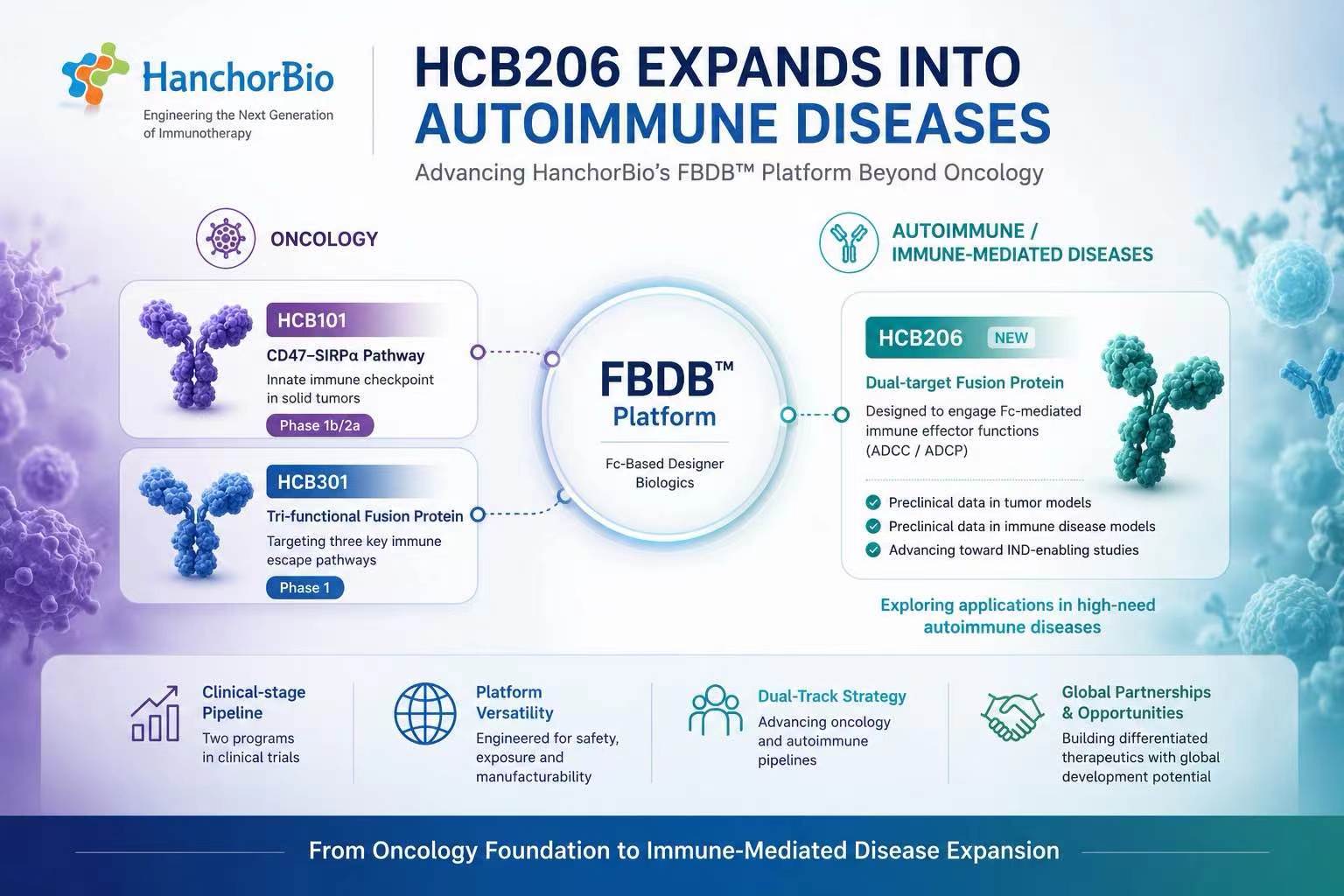
HCB206 is built on HanchorBio’s proprietary FBDB™ platform and is designed to combine targeted cell binding and Fc-mediated immune effector functions, including antibody-dependent cellular cytotoxicity and antibody-dependent cellular phagocytosis. By engaging immune clearance mechanisms against pathogenic or abnormal cells, HCB206 is being evaluated as a potential therapeutic candidate in both malignant B-cell diseases and autoimmune diseases characterized by pathogenic B-cell activity.
In preclinical studies, HCB206 demonstrated tumor growth inhibition across multiple animal tumor models and showed therapeutic potential in immune disease models. HanchorBio has also generated pharmacology data supporting HCB206’s ability to modulate immune cell activity and improve immune microenvironment responses, providing a rationale further IND-enabling development.
“HCB206 is being developed to evaluate whether a dual-target fusion protein approach can extend oncology into autoimmune diseases where pathogenic immune cells contribute to disease activity and relapse,” said Wen-Wu Zhai, Ph.D., Chief Research and Development Officer of HanchorBio. “Based on the preclinical data generated to date, we are advancing formal toxicology studies and other IND-enabling activities while assessing the clinical development pathways in selected autoimmune disease indications.”
“HCB206 represents an important step in HanchorBio’s broader platform strategy,” said Scott Liu, Ph.D., Founder, Chairman, and Chief Executive Officer of HanchorBio. “Our goal is to build a differentiated pipeline of next-generation fusion protein therapeutics that can address complex immune biology across both oncology and immune-mediated diseases. The expansion of HCB206 into autoimmune disease reflects the versatility of our FBDB™ platform and our commitment to developing biologics with global clinical and partnering potential.”
Autoimmune diseases affect a substantial portion of the global population, and many patients require chronic treatment with therapies that may be limited by incomplete response, relapse, infection risk, or long-term immunosuppression. HanchorBio is pursuing a dual-track autoimmune research strategy that includes targeted depletion of pathogenic B-cells as well as multifunctional immune-modulating biologics designed to address T-cell regulation and cytokine-driven inflammation.
HanchorBio currently has two FBDB™-derived drug candidates in clinical development and continues to leverage its platform capabilities to expand its oncology and autoimmune disease pipeline. The company plans to advance HCB206 through IND-enabling studies while exploring and partnering opportunities for next-generation immunotherapies.
About HanchorBio
Based in Taipei, Shanghai, and the San Francisco Bay Area, HanchorBio (7827.TPEx) is a global clinical-stage biotechnology company focused on immuno-oncology and immune-mediated diseases. The company’s proprietary Fc-based designer biologics (FBDB™) platform enables the design of multi-functional biologics intended to modulate innate and adaptive immune pathways with structural control over safety, exposure, and manufacturability. HanchorBio is advancing a portfolio of differentiated biologics designed to address significant unmet medical needs through innovative molecular engineering and scalable CMC strategies.
漢康生技HCB206拓展自體免疫疾病應用,加速推進臨床前關鍵試驗
以癌症免疫療法研發基礎,延伸布局癌症以外高需求疾病領域
漢康生技(TPEx:7827)為一家致力於開發次世代免疫療法、聚焦腫瘤與自體免疫疾病的全球臨床階段生技公司,今日宣布自主研發之HCB206創新雙靶點融合蛋白新藥,在癌症與自體免疫疾病臨床前研究中均展現治療潛力。漢康生技於去年宣布啟動自體免疫疾病研發計畫,本次進展進一步顯示,漢康正將既有癌症免疫療法平台所建立的作用機制,延伸至癌症以外的免疫相關疾病,並加速推進後續臨床前關鍵試驗,朝IND申請與第一期臨床試驗邁進。
HCB206建立於漢康生技FBDBTM平台技術,透過融合蛋白設計,同時強化藥物半衰期及免疫效應功能,包括ADCC(抗體依賴性細胞毒殺作用)與ADCP(抗體依賴性細胞吞噬作用),該設計可協助免疫系統更有效辨識並清除異常細胞;此一機制過去主要應用於癌症治療,如今亦可望延伸至自體免疫疾病,針對造成疾病的異常免疫細胞進行調節與清除。
在臨床前研究中,HCB206於多項動物腫瘤模型中觀察到顯著腫瘤抑制效果;同時,在免疫疾病模式中亦展現治療潛力,支持其作為跨疾病領域免疫調節藥物的開發方向。漢康生技表示,公司已進一步取得HCB206調節免疫細胞活性與改善免疫微環境反應的藥理數據,為後續臨床開發建立基礎。
漢康生技研發長翟文武博士指出,HCB206的開發重點不僅在於癌症適應症,也在於驗證其免疫調節機制可否應用於更廣泛疾病。公司將以既有臨床前數據為基礎,盡速完成正式毒理學試驗與IND申請所需資料,加速推進進入第一期臨床試驗,並評估自體免疫疾病適應症的臨床開發策略。
漢康生技創辦人、董事長暨執行長劉世高博士表示,HCB206代表公司從癌症免疫療法出發、進一步拓展至自體免疫疾病的重要里程碑。未來將持續以FBDBTM平台推進具差異化的新世代融合蛋白藥物,建立癌症與免疫疾病雙軌開發布局,爭取在全球免疫療法市場中創造更具臨床與商業價值的產品線。
自體免疫疾病用藥市場正快速擴大。根據Global Information統計,全球市場規模預估將於2030年達3,362.6億美元,年複合成長率為7.76%;其中免疫療法相關藥物成長動能更為強勁,年複合成長率達11.2%。近年包括Abbvie、強生、Sanofi、Novartis及AstraZeneca等國際大藥廠,皆積極投入新一代自體免疫疾病藥物開發,過去五年累計完成48件授權交易,已揭露交易金額達440億美元。
自體免疫疾病影響全球約一成人口,許多患者需長期接受治療。然而,現有免疫抑制藥物仍常面臨副作用、療效不穩定及復發風險等挑戰。漢康生技正以雙軌研發策略切入此一未滿足醫療需求,一方面鎖定病理性B細胞清除,另一方面開發兼具T細胞調控與細胞因子中和功能的多功能免疫調節藥物,期望為不同類型自體免疫疾病提供更具精準性與差異化的治療選擇。
漢康生技目前已有兩項以FBDB™技術平台開發的創新藥物進入臨床試驗階段。面對全球自體免疫疾病藥物市場持續升溫,公司將持續發揮平台技術優勢,推動癌症與自體免疫疾病雙軌布局,積極拓展全球免疫療法市場機會。
關於漢康生技
漢康生技(股票代碼:7827.TPEx)是一家全球臨床階段的生物技術公司,專注於腫瘤免疫學及自體免疫疾病領域,研發總部設於台北,並在上海及美國舊金山灣區設有運營辦公室。公司由一支在生物藥發現與全球開發方面擁有豐富成功經驗的資深團隊領導,致力於重塑癌症治療格局。漢康生技專有的Fc基礎設計生物藥平台能夠開發具有多種靶向模式的多功能生物藥,旨在激活先天性與適應性免疫通路,以突破當前抗PD-1/L1免疫療法的局限。該平台已在多個體內腫瘤動物模型中成功獲得概念驗證數據。通過差異化的分子研發策略與可規模化的CMC工藝開發,漢康生技正推進一系列創新生物藥管線,致力於解決尚未被滿足的重大醫療需求。