



HanchorBio and Taiwan Cancer Moonshot Project-NTU Subteam Led by Professor Sung-Liang Yu Establish Strategic Collaboration to Advance Precision Oncology
Collaboration connects internationally recognized cancer multi-omics research with HanchorBio’s clinical-stage immuno-oncology platform to accelerate biomarker-driven drug development and strengthen next-generation precision immunotherapy
HanchorBio, Inc. (TWSE: 7827), a global clinical-stage biotechnology company developing next-generation immunotherapies for oncology and immune-mediated diseases, today announced that its wholly owned Taiwan subsidiary has entered into a strategic collaboration with the research team led by Professor Sung-Liang Yu of National Taiwan University, a key participating team in the Taiwan Cancer Moonshot Program (TCMP). The collaboration has been formalized through a memorandum of understanding signed by HanchorBio Taiwan and Professor Yu’s team.
This strategic collaboration represents an important step in HanchorBio’s evolution from a clinical-stage immunotherapy company toward a precision immunotherapy platform integrating patient-derived biological insights, biomarker strategies, proprietary therapeutic engineering, and global clinical development capabilities.
By combining TCMP’s internationally recognized cancer multi-omics and translational research capabilities with HanchorBio’s FBDB™ (Fc-Based Designer Biologics) platform and clinical-stage pipeline, the parties aim to accelerate the development of biomarker-driven immunotherapies and improve the precision of clinical development strategies.
Connecting Discovery, Biomarkers, and Clinical Development
The Taiwan Cancer Moonshot is an Academia Sinica-led precision-oncology research project that brings together investigators from Academia Sinica, National Taiwan University, and leading clinical institutions to characterize the molecular biology of cancers affecting Taiwanese and broader Asian populations. The project has established capabilities in cancer genomics, proteomics, integrated multi-omics analysis, clinically annotated patient-derived datasets, and biomarker discovery.
The project has also contributed to international cancer proteogenomics research involving the U.S. National Cancer Institute’s Clinical Proteomic Tumor Analysis Consortium, or CPTAC, and the International Cancer Proteogenome Consortium. Its scientific contributions include several landmark proteogenomic studies of major cancers in Taiwan, lung adenocarcinoma published in Cell 2020, a cross-population analysis of lung adenocarcinoma across Asian, North American, and Eastern European cohorts, published in Cancer Cell 2025, gastric cancer published in Gut 2026 and breast cancer published in Molecular Cancer 2026.
Strengthening Clinical Development and Through Biological Precision
As immunotherapy advances beyond single checkpoint inhibition, understanding which patients are most likely to benefit and why has become increasingly important.
Through this collaboration, HanchorBio and Professor Yu’s team will explore how integrated molecular and immune profiling can support next-generation immunotherapy development, including:
- Identification of potential biomarkers associated with treatment response, resistance, and patient selection;
- Understanding how tumor biology influences innate and adaptive immune responses;
- Evaluating the relationship between macrophage-mediated immune regulation, T-cell functional states, and therapeutic outcomes;
- Integrating patient-derived molecular insights with clinical development strategies for HanchorBio’s pipeline.
These capabilities may help improve clinical trial design, enhance translational understanding, and support more precise development approaches for next-generation immunotherapies.
Building a Differentiated Precision Immunotherapy Platform
“The Taiwan Cancer Moonshot has established internationally recognized excellence in cancer proteogenomics, multi-omics, and patient-derived translational research, particularly in Asian cancer populations,” said Scott Liu, PhD, Founder and Chairman of HanchorBio. “The significance of this strategic collaboration is that it brings TCMP’s capabilities directly into the drug-development process. By connecting Professor Yu’s expertise and the TCMP’s resources with HanchorBio’s clinical-stage portfolio and FBDB™ platform, we aim to answer specific development questions: which patients are most likely to benefit, what biology drives response or resistance, and how biomarker strategies can make clinical development more precise. This includes understanding how tumor-intrinsic biology, macrophage-mediated immune regulation, and adaptive immune responses, including T-cell functional states, contribute to treatment response, resistance, and durability. Our goal is to translate patient-derived molecular insights into better development strategies and ultimately better therapies.”
From Patient-Derived Discovery to Precision Immunotherapy
Chair and Professor Sung-Liang Yu of Department of Clinical Laboratory Sciences and Medical Biotechnology, National Taiwan University said:
“The Taiwan Cancer Moonshot has generated extensive molecular and clinical insights through the systematic study of cancers affecting Taiwanese and East Asian populations. Collaboration with a clinical-stage biotechnology company creates an important opportunity to evaluate these discoveries in the context of defined therapeutic mechanisms and active drug-development programs. By combining patient-derived research and multi-omics analysis with HanchorBio’s drug-development capabilities, we aim to shorten the path from scientific discovery to biomarkers, patient-selection strategies, and potential clinical applications.”
Together, the parties aim to establish a translational model:
PATIENT-DERIVED DISCOVERY → MOLECULAR & IMMUNE INSIGHT → BIOMARKER-GUIDED CLINICAL DEVELOPMENT → PRECISION IMMUNOTHERAPY
Strategic Significance of HanchorBio
This collaboration strengthens three strategic pillars of HanchorBio’s long-term value creation:
- Improving clinical development precision
By integrating patient-derived molecular data and immune profiling, HanchorBio aims to improve understanding of treatment response, resistance mechanisms, and patient selection strategies.
- Expanding platform differentiation
The combination of discovery capabilities, biomarker strategies, FBDB™ therapeutic engineering, and clinical development creates a differentiated precision immunotherapy ecosystem beyond individual drug candidates.
- Supporting global innovation from Taiwan
The collaboration connects Taiwan’s internationally recognized cancer research capabilities with a globally oriented clinical-stage biotechnology company, supporting the translation of Taiwan-originated scientific innovation into global therapeutic development.
About HanchorBio
Based in Taipei, Shanghai, and the San Francisco Bay Area, HanchorBio (TWSE: 7827) is a global clinical-stage biotechnology company focused on immuno-oncology and immune-mediated diseases. Company’s proprietary Fc-based designer biologics (FBDB™) platform enables the engineering of multi-functional biologics with diverse targeting modalities, designed to activate both innate and adaptive immune pathways and address limitations of current immunotherapies.
HanchorBio is advancing a portfolio of innovative biologics designed to address significant unmet medical needs through differentiated molecular configurations, translational development strategies, and scalable CMC capabilities. For more information, please visit: https://www.HanchorBio.com
Forward-Looking Statements
This press release contains forward-looking statements regarding HanchorBio’s research collaborations, development programs, product candidates, regulatory strategy, and future plans. Actual results may differ materially from those expressed or implied due to various risks and uncertainties, including clinical development outcomes, regulatory interactions, regulatory decisions, protocol development, and market conditions. HanchorBio undertakes no obligation to update forward-looking statements except as required by applicable law.
漢康-KY子公司與臺灣癌症登月計畫俞松良教授團隊建立戰略合作 共同推進精準腫瘤醫學
結合國際級癌症多體學研究與漢康生技臨床階段腫瘤免疫平台,加速生物標記導向的新藥開發
【台北、上海、舊金山,2026 年 8 月 7 日】-全球臨床階段生技公司漢康生技-KY(HanchorBio, Inc.,TWSE:7827)今日宣布,旗下臺灣全資子公司漢康生技與國立臺灣大學俞松良教授所帶領、參與「臺灣癌症登月計畫」的研究團隊建立戰略合作關係。雙方並由漢康生技與俞松良教授團隊正式簽署合作備忘錄。
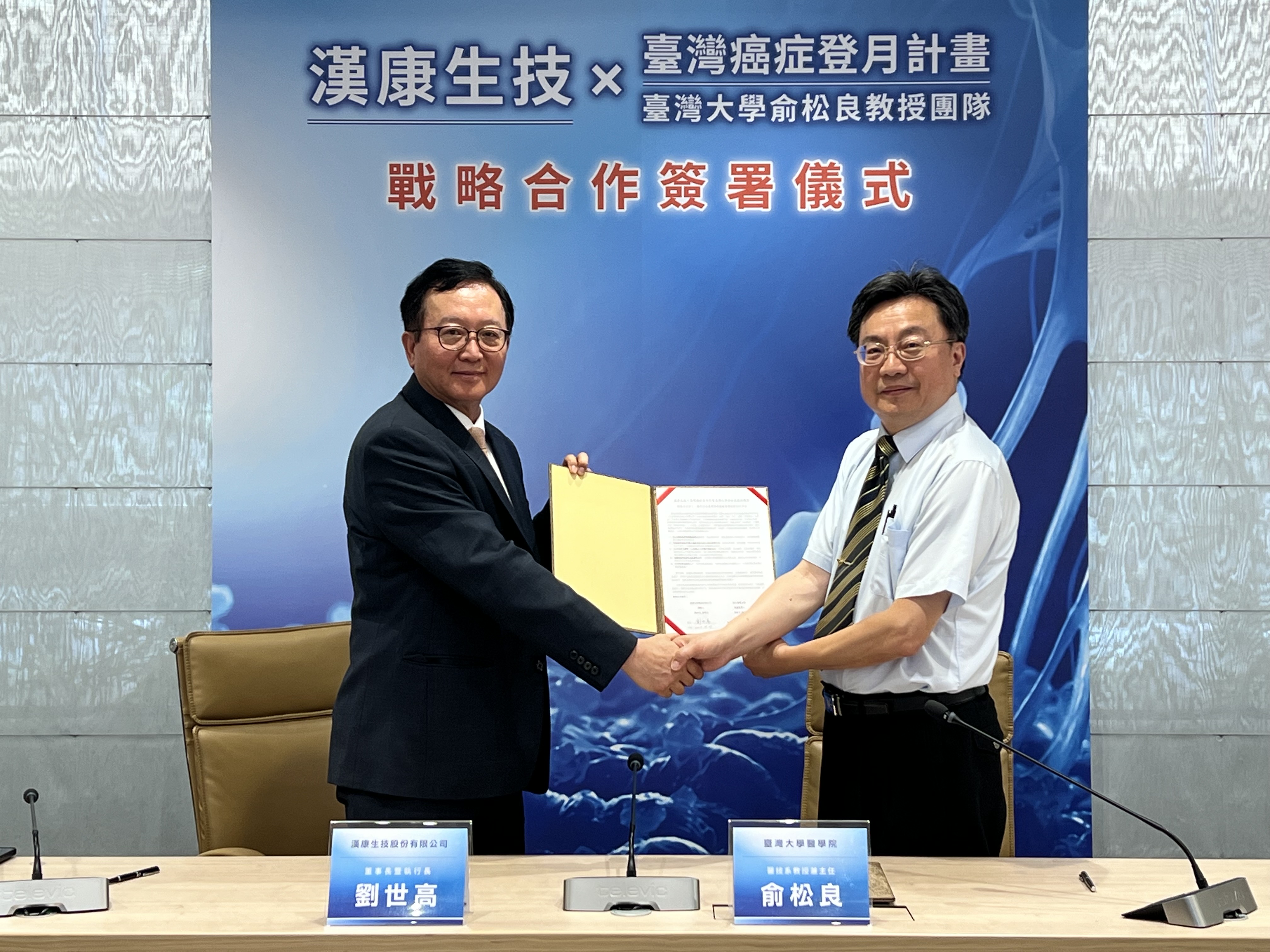
漢康生技董事長劉世高(左)與臺灣大學醫技系主任俞松良教授(右)研究團隊今日完成共同研究開發合作備忘錄簽署。
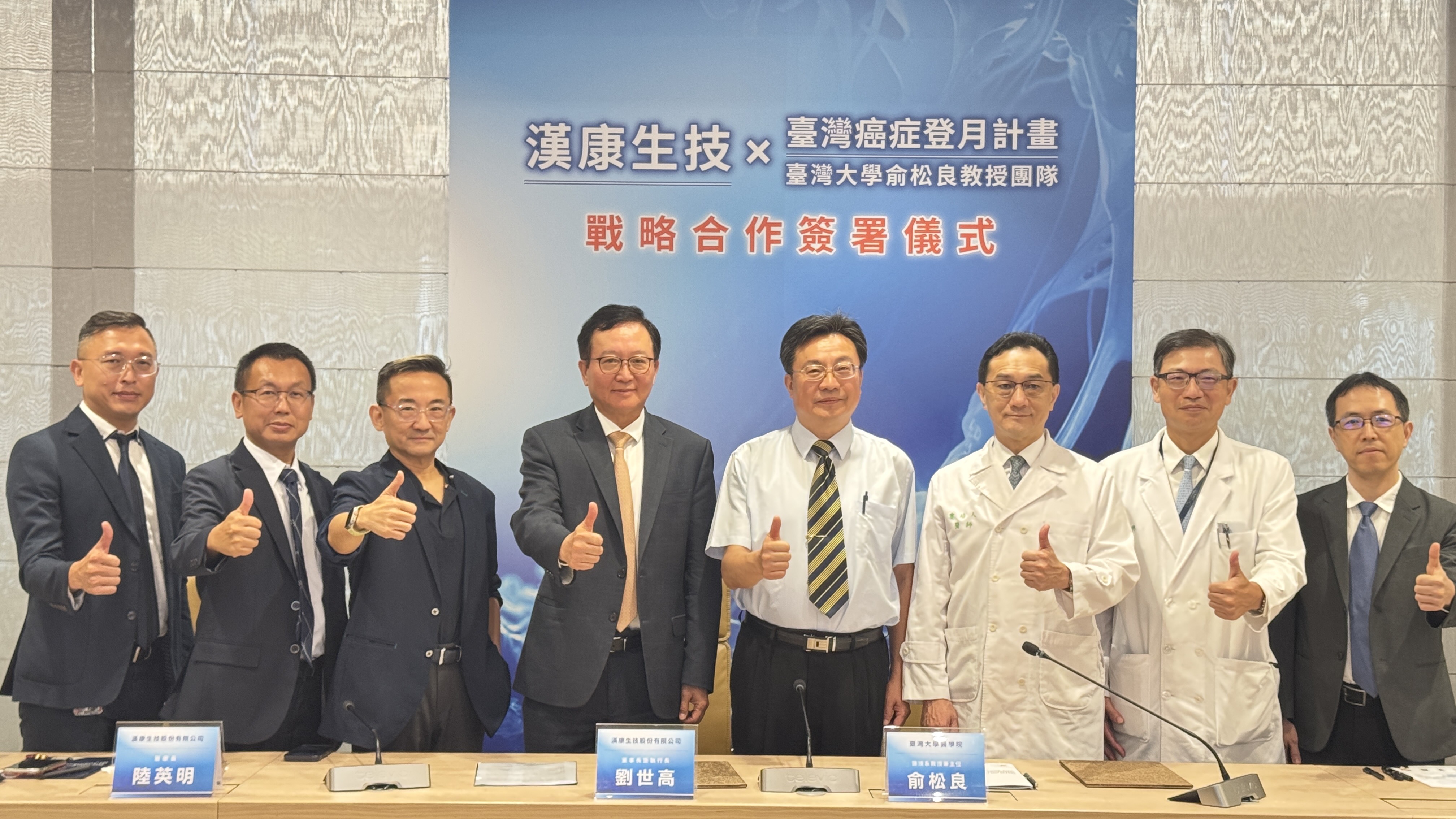
漢康生技財務長曾木增、醫療長陸英明、董事長劉世高、臺灣大學醫技系主任俞松良、臺大醫院教授婁培人、臺大醫院副院長陳晉興、臺灣大學醫學院副院長潘俊良
漢康生技致力於開發應用於腫瘤及免疫相關疾病的次世代免疫療法。本次合作將串聯臺灣癌症登月計畫在癌症多體學、病人來源研究及臨床轉譯方面的研究能力,以及漢康生技的 FBDB™ 藥物開發平台、臨床階段腫瘤產品線與全球新藥開發能力,加速科學研究成果轉化為可應用於藥物與臨床開發的具體策略。
臺灣癌症登月計畫建立亞洲癌症多體學研究基礎
臺灣癌症登月計畫由中央研究院主導,串聯國立臺灣大學及多家臨床醫療機構的臺灣研究團隊,聚焦臺灣及亞洲族群常見癌症的分子特徵,並已建立癌症基因體、蛋白體、整合多體學分析、病人來源資料與生物標記研究能力。相關團隊亦參與美國國家癌症研究所臨床蛋白體腫瘤分析聯盟(CPTAC)及國際癌症蛋白基因體聯盟等國際研究合作,並曾於《Cell》、《Cancer Cell》、《Gut》及《Molecular Cancer》等國際期刊發表重要癌症研究成果。
串聯病人來源研究與臨床階段藥物開發
本次合作將把癌症多體學及臨床轉譯研究能力,導入漢康生技的 FBDB™ 藥物開發平台與臨床階段腫瘤產品開發計畫。
雙方將嘗試把癌症病人及具臨床註記生物檢體所提供的分子資訊,與明確的藥物作用機制、治療暴露情形及臨床結果相互連結,進一步評估治療反應生物標記、病人篩選策略、轉譯研究方向,以及次世代免疫療法潛在伴隨式診斷策略。
整合性的腫瘤分子與免疫特徵分析,也有助於進一步了解腫瘤本身的生物學特性,如何影響先天性與適應性免疫反應,包括巨噬細胞介導的免疫調控、T 細胞活化與啟動,以及持久性免疫反應的形成。相關研究結果可望為下一代免疫療法的生物標記策略及治療開發方向提供科學依據。
漢康生技創辦人暨董事長劉世高博士表示:
「臺灣癌症登月計畫在癌症蛋白基因體學、多體學及病人來源轉譯研究方面,已建立受到國際肯定的研究基礎,尤其累積了許多與亞洲癌症族群相關的重要成果。本次戰略合作的關鍵,在於將這些研究能力更直接地導入藥物開發流程。」
「透過結合俞松良教授團隊及臺灣癌症登月計畫的研究資源,以及漢康生技的臨床階段產品線與 FBDB™ 平台,我們希望回答藥物開發中的具體問題,包括哪些病人較可能從治療中獲益、哪些生物機制驅動治療反應或抗藥性,以及如何透過生物標記讓臨床開發更加精準。這也涵蓋腫瘤內在生物學、巨噬細胞介導的免疫調控,以及包括 T 細胞功能狀態在內的適應性免疫反應,如何共同影響治療反應、抗藥性與療效持久性。」
連結科學發現與臨床開發
雙方初期合作將聚焦於以下相互關聯的研究方向:
一、運用多體學、功能基因體學及病人來源生物資訊,解析腫瘤生物學、免疫反應及潛在治療敏感性或抗藥機制,包括腫瘤細胞、先天免疫細胞與適應性免疫反應之間的交互作用。
二、研究與治療反應、疾病進展及免疫抗藥性相關的生物標記,以及腫瘤與免疫微環境之間的交互作用。
三、整合分子資料、具臨床註記的檢體、生物資料庫及多中心臨床研究能力。
四、在具備充分科學及臨床依據的情況下,評估診斷或伴隨式診斷的潛在應用。
五、支持具國際競爭力的研究計畫、科學論文發表、智慧財產權建立,以及更廣泛的學術與產業合作。
在此合作架構下,癌症多體學研究所發現的生物學特徵,可進一步與特定藥物作用機制、治療暴露、臨床結果,以及漢康生技臨床前與臨床開發計畫所提出的研究問題進行交叉驗證。
國立臺灣大學醫學檢驗暨生物技術學系俞松良教授表示:
「臺灣癌症登月計畫透過對臺灣及東亞族群癌症進行系統性研究,已累積廣泛的分子與臨床資訊。與臨床階段生技公司合作,提供了一項重要機會,讓這些研究發現可以放入明確的治療機制及實際進行中的藥物開發計畫中加以評估。」
「透過結合病人來源研究、多體學分析及漢康生技的藥物開發能力,我們希望縮短科學發現轉化為生物標記、病人篩選策略及潛在臨床應用的路徑。」
建立精準免疫治療的轉譯合作模式
本次合作結合既有的癌症蛋白基因體研究基礎,以及漢康生技的治療技術平台、臨床階段產品與全球藥物開發能力,期望建立一條由病人來源研究直接連結至臨床開發應用的轉譯路徑:
病人來源研究發現 → 分子與免疫機制解析 → 生物標記導向的臨床開發 → 精準免疫治療
透過此一合作模式,雙方將推動多體學研究成果轉化為可驗證的藥物開發假說,提升臨床開發策略的生物學精準度,並支持源自臺灣的創新療法與精準醫療技術走向全球開發。
關於漢康-KY:
英屬開曼群島商漢康生技股份有限公司(以下簡稱“漢康-KY”,股票代碼:7827)成立於2020年,由具豐富國際藥物開發與運營經驗的劉世高博士創辦。公司專注於腫瘤免疫藥物研發,透過自主建立的核心「FBDB多功能融合蛋白技術平台」開發出8+種創新蛋白生物藥,具有廣譜抗癌潛力,可抑制多種實體瘤及血液腫瘤,並持續取得多項專利。其中HCB101與HCB301已進入臨床試驗階段,而HCB101在2025年6月更完成首項國際授權,總授權金達2.02億美元。漢康-KY的策略是以多功能生物藥克服現行採取免疫療法與化療並行的高失敗率,同時藉由啟動先天性免疫和適應性免疫體系以摧毀腫瘤,致力提供高效且可負擔的新一代腫瘤免疫治療方案,解決未滿足的醫療需求。更
聲明:
本新聞稿及同時發佈之相關資訊內含有預測性敘述;其內容乃根據既有之風險及可能的不確定性進行判斷及預測,包括:市場因素與其他非漢康-KY(以下簡稱本公司)所能掌控之原因。這些預測性敘述是基於現況的預測和評估,除非基於法律的要求,本公司不負日後更新之責。