



HanchorBio Showcases HCB101 Myeloid-Enhancer Strategy in Gastric Cancer and HNSCC at JCA-AACR 2026
Poster presentations highlight HCB101’s differentiated SIRPα-Fc strategy across upper digestive and head and neck cancers
[Taipei, Shanghai, San Francisco | June 30, 2026] – HanchorBio, Inc. (TWSE : 7827), a global clinical-stage biotechnology company advancing next-generation immunotherapies for oncology and autoimmune diseases, today announced poster presentations of HCB101 clinical data at the 9th Japanese Cancer Association (JCA) and the American Association for Cancer Research (AACR) Special Joint Conference on Novel Therapies and Diagnostics in Upper Digestive and Head and Neck Cancers, taking place June 28-30, 2026, in Kyoto, Japan.
HCB101 is HanchorBio’s differentiated engineered SIRPα-IgG4 fusion protein designed to selectively block CD47–SIRPα “don’t eat me” signaling while reducing red-blood-cell binding. By restoring macrophage-mediated tumor-cell phagocytosis and supporting antigen presentation, HCB101 is being developed as a myeloid-enhancing immune backbone for rational combination therapy, with second-line gastric/gastroesophageal junction cancer as the lead clinical development focus. This strategy is particularly relevant in upper digestive and head and neck cancers, where myeloid-rich tumor microenvironments, impaired antigen presentation, immune exclusion, and treatment resistance continue to limit durable benefit.
“HCB101 is the clinical anchor of HanchorBio’s myeloid enhancer platform and our first major validation point for SIRPα-backbone biology,” said Scott Liu, PhD, Founder, Chairman, and CEO of HanchorBio. “Our strategy begins with second-line gastric cancer as the lead clinical anchor, then extends into first-line gastric cancer, HNSCC, colorectal cancer, and other selected solid tumors where myeloid biology and the tumor microenvironment play important roles. Over time, we believe this platform can expand from CD47–SIRPα biology into broader multi-axis myeloid tumor microenvironment modulation, and potentially beyond oncology into autoimmune, cardiovascular, and CNS diseases.”
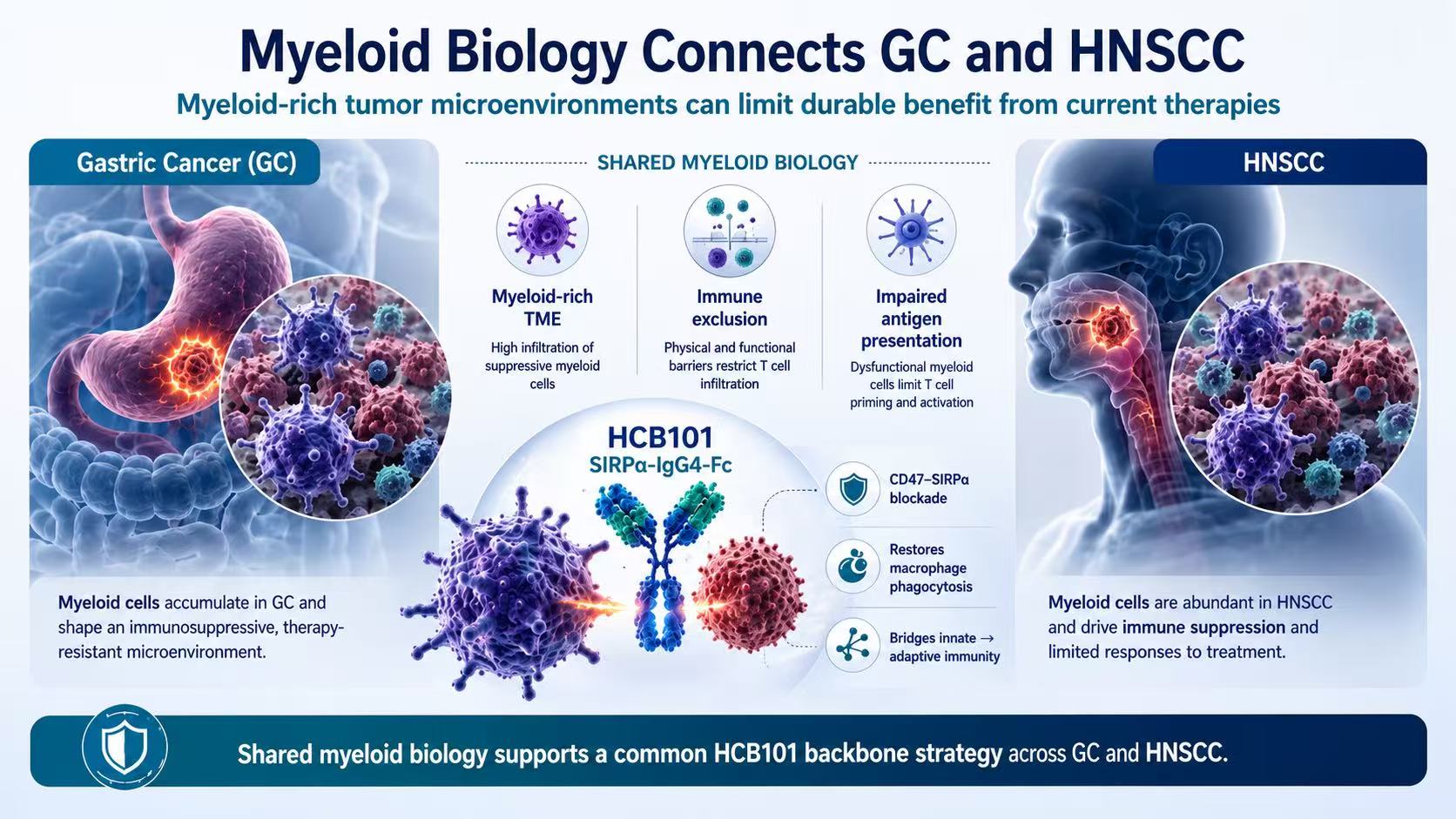
Gastric Cancer: Lead Clinical Anchor for HCB101
In gastric cancer, HCB101 was evaluated in the ongoing Phase 1b/2a HCB101-201 study (NCT06771622) in combination with standard-of-care regimens. In second-line gastric/gastroesophageal junction (GEJ) cancer, HCB101 plus ramucirumab and paclitaxel demonstrated encouraging preliminary antitumor activity, with the most mature signal observed in the 5.12–8 mg/kg mid-dose cohorts. Across 15 efficacy-evaluable patients, dose-related antitumor activity was observed, including an 80% objective response rate in the mid-dose cohorts and a disease control rate of 93.3% across the overall cohort. The regimen showed a manageable safety profile, with no unexpected overlapping toxicities observed.
The gastric cancer poster also included preliminary data from first-line HER2-positive gastric/GEJ cancer, where HCB101 was combined with trastuzumab, pertuzumab, and CAPEOX. This regimen highlights an important aspect of HCB101’s combination strategy: CD47–SIRPα blockade may be most effective when paired with functional macrophage engagement. Trastuzumab and pertuzumab provide HER2-directed, Fc-active tumor targeting, while HCB101 is designed to restore macrophage-mediated phagocytosis of tumor cells. In this setting, HCB101-based combination therapy demonstrated preliminary activity, including a 75% objective response rate and 100% disease control rate across the overall cohort.
“HCB101’s second-line GC data are important because this is a clinically defined setting with an established standard-of-care comparator, interpretable endpoints, and a clear potential registrational pathway,” said Alvin Luk, PhD, MBA, CCRA, President & Chief Medical Officer (Group) and CEO (U.S.A.) of HanchorBio. “Our priority is to convert the current 2L GC signal into a disciplined development path, including dose and schedule optimization, regulatory alignment, and a randomized strategy that can support future registration. From this anchor, we can extend HCB101 into broader GI cancers and selected solid tumors where anti-VEGF, EGFR, HER2, chemotherapy, and immuno-oncology combinations provide rational settings for myeloid-enhanced tumor clearance.”
HNSCC: Encouraging Expansion Signal in a Myeloid-Rich Tumor Setting
In head and neck squamous cell carcinoma, HCB101 data were presented across monotherapy and combination settings. In the ongoing Phase 1a HCB101-101 monotherapy study (NCT05892718), HCB101 demonstrated a clinically manageable safety profile and preliminary activity, including a confirmed partial response in a patient with HNSCC (ongoing >72 weeks) and durable stable disease in additional HNSCC and nasopharyngeal carcinoma patients.
The HNSCC poster also included early data from a Taiwan investigator-initiated combination study (NCT07136545) of HCB101 with pembrolizumab in recurrent/metastatic HNSCC. Among the three PD-1–naïve patients treated at 1.28 mg/kg, early tumor regression was observed, including one complete response, one partial response, and one stable disease. These early findings require prospective confirmation, but support continued evaluation of HCB101 in HNSCC, including rational combinations with pembrolizumab and cetuximab.
HanchorBio plans to continue advancing HCB101 in gastric cancer, HNSCC, and other selected solid tumors where CD47–SIRPα biology, macrophage-mediated immunity, and rational standard-of-care combinations may support meaningful clinical benefit.
Poster Presentation Details
Title: HCB101 SIRPα-Fc fusion protein in gastric cancer: clinical activity in second-line and first-line combination settings
Session: Poster Presentation
Location: Kyoto Tokyu Hotel
Date/Time: June 29, 2026 (16:45 to 17:45 JST)
Title: Preliminary clinical activity of HCB101, a SIRPα-Fc fusion protein, in HNSCC across monotherapy and combination settings
Session: Poster Presentation
Location: Kyoto Tokyu Hotel
Date/Time: June 29, 2026 (16:45 to 17:45 JST)
About HanchorBio
Based in Taipei, Shanghai, and the San Francisco Bay Area, HanchorBio (TWSE : 7827) is a global clinical-stage biotechnology company focused on immuno-oncology and immune-mediated diseases. The company is led by an experienced team with a proven track record in biologics discovery and global development, aiming to reshape the landscape of cancer therapies. HanchorBio’s proprietary Fc-based designer biologics (FBDB™) platform enables the design of multi-functional biologics with diverse targeting modalities, designed to activate both innate and adaptive immune pathways and overcome the current challenges of anti-PD1/L1 immunotherapies. The FBDB™ platform has delivered proof-of-concept data in several in vivo tumor animal models. HanchorBio is advancing a portfolio of innovative biologics designed to address significant unmet medical needs through differentiated molecular configurations in R&D and scalable CMC strategies.
Forward-Looking Statements
This press release contains forward-looking statements regarding HanchorBio’s clinical development programs, product candidates, regulatory strategy, and future plans. Actual results may differ materially from those expressed or implied due to various risks and uncertainties, including clinical development outcomes, regulatory decisions, and market conditions. HanchorBio undertakes no obligation to update forward-looking statements except as required by applicable law.