



HanchorBio Receives FDA Pre-IND Feedback
Supporting Advancement of HCB303, a Next-Generation Trispecific Immunotherapy
FDA feedback supports HanchorBio’s planned U.S. clinical development strategy for HCB303, further validating the Company’s ability to advance differentiated multispecific biologics from its FBDB™ platform
TAIPEI, SHANGHAI, and SAN FRANCISCO — August 12, 2026 — HanchorBio, Inc. (TWSE: 7827), a global clinical-stage biotechnology company developing next-generation immunotherapies for oncology and immune-mediated diseases, today announced that it has received written responses from the U.S. Food and Drug Administration (FDA) following a Type B pre-Investigational New Drug (pre-IND) submission for HCB303, the Company’s next-generation, first-in-class trispecific immunotherapy designed to simultaneously activate innate and adaptive antitumor immunity.
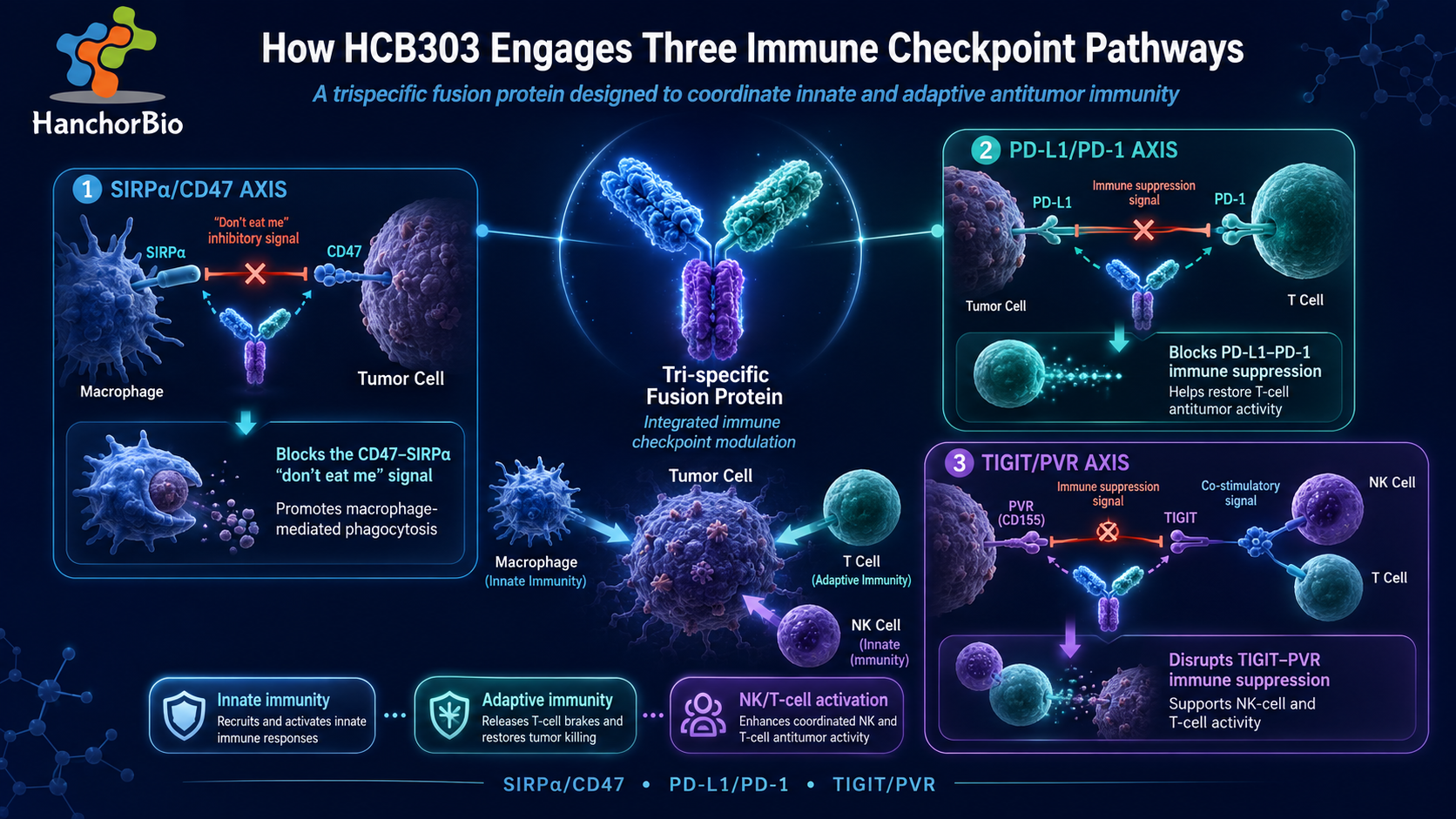
HCB303 is a humanized trispecific fusion protein developed through HanchorBio’s proprietary Fc-Based Designer Biologics (FBDB™) platform. The molecule is designed to modulate three complementary immune pathways—SIRPα/CD47, PD-L1/PD-1, and TIGIT/PVR—within a single therapeutic architecture, thereby coordinating macrophage-mediated phagocytosis, T-cell immunity, and NK-cell antitumor activity.
The FDA’s written responses addressed HanchorBio’s proposed chemistry, manufacturing and controls (CMC), nonclinical, clinical pharmacology, and first-in-human clinical development strategy. The Agency indicated that the Company’s nonclinical studies appear sufficient to support the proposed Phase 1 study and that the proposed approach to determining the starting dose and dose-escalation strategy appears reasonable, subject to review of the complete IND submission.
The FDA also provided guidance regarding clinical safety monitoring, dose-limiting toxicity definitions, pharmacokinetic and pharmacodynamic assessments, and other elements of the planned Phase 1 program. HanchorBio intends to incorporate this feedback into the IND package as it advances HCB303 toward U.S. clinical development.
“HCB303 represents much more than the advancement of another molecule. It demonstrates product-enabling power and scalability of our FBDB™ platform to repeatedly generate differentiated, multifunctional biologics designed around complex human immunobiology,” said Scott Liu, PhD, Founder, Chairman, and CEO of HanchorBio. “With HCB101 already establishing our clinical foundation in innate immune checkpoint biology, HCB301 advancing a trispecific strategy in the clinic, and now HCB303 moving toward IND submission, we are building a pipeline—not a single-product company. Our ambition is to create an engine capable of continuously translating biological insight into globally differentiated medicines.”
A New Trispecific Strategy Across Innate and Adaptive Immunity
Cancer immune resistance rarely results from a single suppressive pathway. HCB303 was therefore engineered to integrate three distinct yet complementary mechanisms into a single molecule.
The SIRPα component is designed to disrupt CD47-mediated “don’t eat me” signaling, enhance macrophage-mediated phagocytosis of tumor cells, and promote de novo activation of T cell clones. PD-L1 blockade is intended to restore adaptive T-cell antitumor activity, while modulation of the TIGIT/PVR axis is designed to relieve immune suppression affecting NK and T cells while preserving CD226-mediated co-stimulatory signaling. By integrating these mechanisms into a single trispecific molecule, HanchorBio aims to coordinate immune activation across macrophages, T cells, and NK cells simultaneously within the tumor microenvironment, potentially achieving a pharmacologic profile distinct from that of administering multiple independent agents.
HCB303 builds upon HanchorBio’s broader strategy of moving beyond single-checkpoint inhibition toward rationally engineered multifunctional immunotherapies capable of addressing the interconnected immune suppression in the tumor microenvironment.
“The next generation of immunotherapy will increasingly be defined not simply by how many targets a molecule contains, but by whether those targets solve a coherent biological problem,” said Alvin Luk, PhD, MBA, President and CMO (Group) & CEO (USA) of HanchorBio. “HCB303 was designed around that principle. By simultaneously addressing myeloid immune suppression, PD-1/PD-L1-mediated adaptive resistance, and the TIGIT/PVR axis, we can influence three major components of antitumor immunity—macrophages, T cells, and NK cells—within one therapeutic architecture. The FDA interaction gives us a clear framework to translate that biology into a disciplined first-in-human development program.”
FDA Feedback Provides a Path Toward First-in-Human Development
HanchorBio’s proposed Phase 1 study is designed to evaluate HCB303 in patients with advanced solid tumors, with tumor types prioritized according to the biological relevance of PD-L1 signaling, TIGIT/PVR-mediated immune suppression, and myeloid-driven immunosuppression.
The proposed clinical program includes once-weekly intravenous administration beginning at 0.03 mg/kg, using a Bayesian Optimal Interval (BOIN) dose-escalation design with a target dose-limiting toxicity rate of 25%. Based on its review of the pre-IND package, the FDA stated that the Company’s nonclinical studies appear sufficient to support the proposed Phase 1 trial. The Agency also indicated that HanchorBio’s approach to determining the starting dose and dose-escalation plan appears reasonable.
The proposed initial study involves a stepwise weekly dose-escalation strategy, while retaining the flexibility to evaluate alternative dose-optimization approaches as human pharmacokinetic and safety data emerge. The clinical development program will incorporate comprehensive PK, pharmacodynamic, receptor occupancy, immune biomarker, immunogenicity, safety, and preliminary antitumor activity assessments to characterize HCB303 and guide selection of recommended dose levels for subsequent clinical development.
From HCB101 to HCB301 to HCB303: Building a Multispecific Immunotherapy Pipeline
HCB303 represents the latest advancement from HanchorBio’s expanding FBDB™ pipeline.
HCB101, the Company’s lead SIRPα-based innate immune checkpoint program, is currently in clinical development across multiple solid tumors and is establishing the translational and clinical foundation for targeting macrophage biology.
HCB301, HanchorBio’s first clinical-stage trispecific program, integrates modulation of SIRPα, PD-L1, and the TGF-β pathway into a single molecule and is currently being evaluated in a Phase 1 clinical study. HCB303 extends this strategy by combining SIRPα and PD-L1 modulation with the TIGIT/PVR immune axis, creating another distinct trispecific architecture designed to address complementary mechanisms of immune resistance.
Together, these programs illustrate HanchorBio’s broader development strategy:
Validated biology → differentiated therapeutic architecture → translational evidence → global clinical development
HanchorBio plans to incorporate the FDA’s recommendations into the final IND-enabling package and advance HCB303 toward U.S. IND submission.
About HCB303
HCB303 is an investigational humanized trispecific fusion protein developed using HanchorBio’s proprietary FBDB™ platform. HCB303 is designed to simultaneously modulate the SIRPα/CD47, PD-L1/PD-1, and TIGIT/PVR immune pathways, thereby engaging complementary components of innate and adaptive antitumor immunity.
The program is designed to enhance macrophage-mediated phagocytosis, restore T-cell antitumor activity, and enhance NK-cell function by addressing multiple mechanisms of immune suppression within a single therapeutic architecture. HCB303 is currently in IND-enabling development and has not been approved by any regulatory authority.
About HanchorBio
HanchorBio (TWSE: 7827) is a global clinical-stage biotechnology company dedicated to developing next-generation immunotherapies for oncology and immune-mediated diseases. The Company’s proprietary Fc-Based Designer Biologics (FBDB™) platform enables the engineering of differentiated multifunctional biologics that simultaneously modulate complementary immune pathways.
HanchorBio’s pipeline includes HCB101, its lead SIRPα-based innate immune checkpoint program; HCB301, a clinical-stage trispecific immunotherapy targeting SIRPα, PD-L1, and TGF-β biology; HCB303, a next-generation trispecific program integrating SIRPα, PD-L1, and TIGIT/PVR biology; and additional programs across oncology and immune-mediated diseases.
With operations spanning Taiwan, China, and the United States, HanchorBio is building an integrated global development organization connecting therapeutic engineering, translational science, clinical development, and regulatory execution. For more information, please visit HanchorBio.com.
Forward-Looking Statements
This press release contains forward-looking statements, including statements regarding the development of HCB303, the timing and potential submission of an IND, initiation and design of future clinical studies, potential therapeutic characteristics and mechanisms of HCB303, development of HanchorBio’s pipeline, and the capabilities and potential of the FBDB™ platform. These statements are based on current expectations and assumptions and involve risks and uncertainties that could cause actual results to differ materially from those described. Regulatory feedback does not constitute approval of an IND or assurance that clinical development will proceed as planned. HanchorBio undertakes no obligation to update forward-looking statements except as required by applicable law.