



HanchorBio Presents Two Oral Presentations at ESMO TAT Asia 2026 Highlighting Progress Across Its Next-Generation Immunotherapy Pipeline
Clinical data from HCB101 and first-in-human data from HCB301 support HanchorBio’s strategy to develop
multi-target immunotherapies addressing key mechanisms of tumor immune resistance
[Taipei, Shanghai, San Francisco | June 13, 2026] – HanchorBio, Inc. (TWSE: 7827), a global clinical-stage biotechnology company advancing next-generation immunotherapies for oncology and autoimmune diseases, today announced that two company-sponsored clinical programs were featured in oral presentations at the European Society for Medical Oncology Targeted Anticancer Therapies Asia Congress 2026, ESMO TAT Asia 2026, held in Hong Kong.
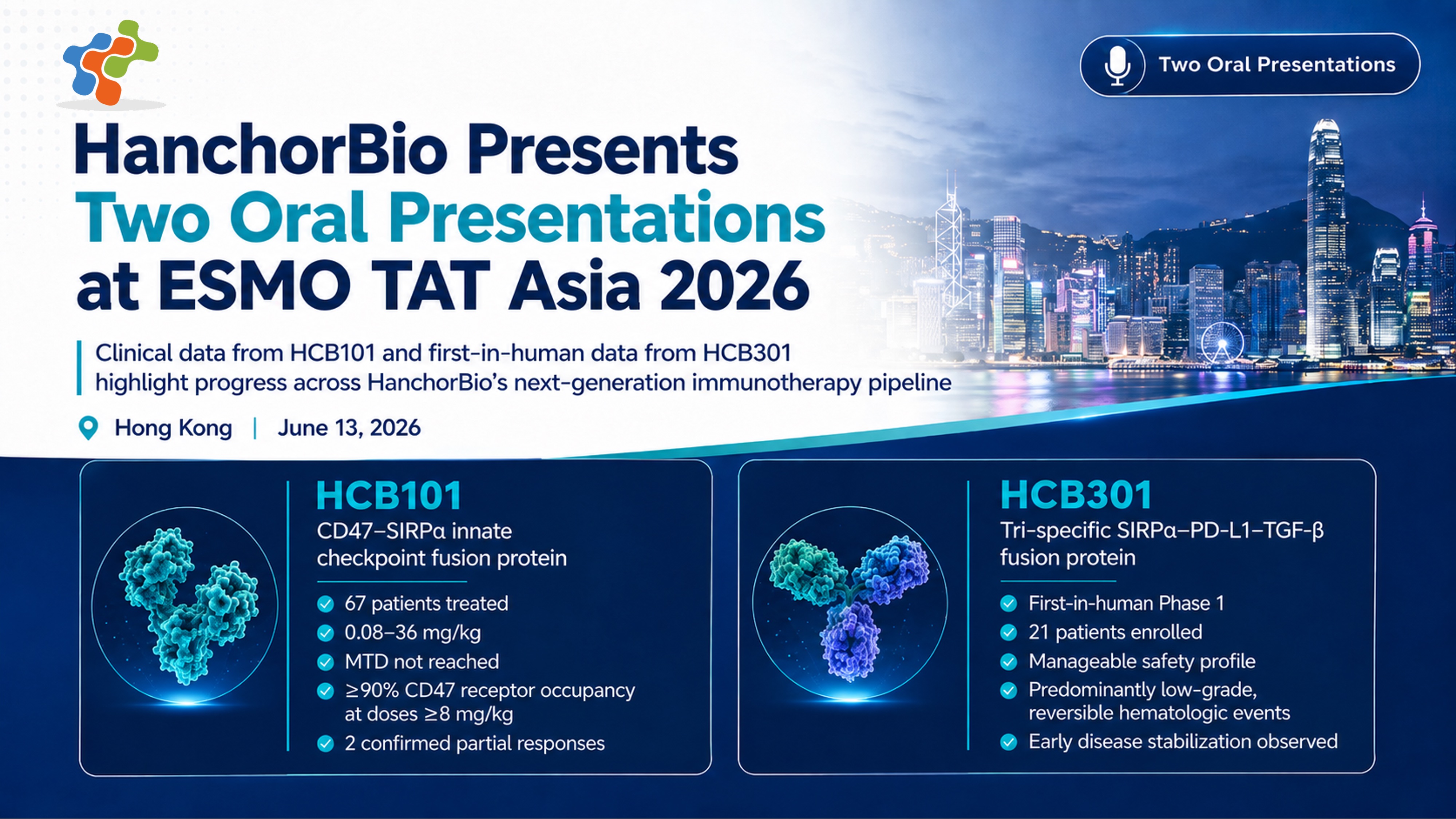
The presentations highlighted clinical and translational progress for HCB101, HanchorBio’s SIRPα-Fc innate checkpoint fusion protein targeting the CD47-SIRPα axis, and HCB301, a tri-specific SIRPα-PD-L1-TGF-β fusion protein designed to coordinate modulation of the SIRPα, PD-L1, and TGF-β pathways in a single molecule.
In the HCB101 oral presentation, based on a May 2026 data cutoff, updated Phase 1a monotherapy data from HCB101-101 (NCT05892718) showed that 67 patients had been treated at doses ranging from 0.08 mg/kg to 36 mg/kg without reaching the maximum tolerated dose. Two dose-limiting toxicities of thrombocytopenia were observed, one Grade 3 at 2.56 mg/kg and one Grade 4 at 36 mg/kg, with no bleeding events reported. Treatment-related adverse events were predominantly Grade 1–2, with one Grade 3 anemia event and no cumulative anemia or febrile neutropenia signal observed. HCB101 also demonstrated linear pharmacokinetics and sustained CD47 receptor occupancy of ≥90% at doses ≥8 mg/kg. Preliminary antitumor activity was observed in this heavily pretreated population (median of 3 prior lines of treatment), including two confirmed partial responses: one in head and neck squamous cell carcinoma (with ~42% tumor reduction and ongoing response beyond 69 weeks), and one in marginal zone lymphoma (with ~89% metabolic reduction at Week 16). Eleven additional patients achieved durable stable disease across multiple tumor types.
The accepted HCB101 abstract also reported combination dose-escalation data from HCB101-201, a Phase 1b/2 multi-cohort combination study (NCT06771622), including activity in second-line gastric cancer and first-line HER2-positive gastric cancer. In second-line gastric cancer, 15 efficacy-evaluable patients achieved an overall response rate of 60% across 2.56–12 mg/kg, while the 5.12–8 mg/kg mid-dose cohorts achieved an ORR of 80%, with maximal tumor regression of 78.2% and ongoing responses beyond 36 weeks. In 1L HER2-positive gastric cancer, 5 efficacy-evaluable patients achieved an ORR of 80% (4/5) and a disease control rate of 100%. Anti-tumor activity was also observed in additional Phase 1b/2 cohorts, including PD-1-based combinations.
“Having two oral presentations at ESMO TAT Asia is an important recognition of the clinical progress we are making across our immune-modulation platform,” said Scott Liu, PhD, Founder, Chairman, and CEO of HanchorBio. “The HCB101 data continue to support a differentiated therapeutic window for CD47-SIRPα inhibition, while the first-in-human HCB301 data show that coordinated multi-pathway immune modulations can be translated into the clinic.”
In the HCB301 oral presentation, first-in-human Phase 1 data supported the clinical feasibility of the tri-specific immune modulation across the SIRPα, PD-L1, and TGF-β pathways. Among 21 patients enrolled across early dose levels, HCB301 demonstrated a manageable safety profile, predominantly low-grade and reversible hematologic events, and early disease stabilization in heavily pretreated patients with advanced solid tumors. These early data support continued dose escalation to further evaluate safety, pharmacokinetics, pharmacodynamics, and preliminary antitumor activity.
“Together, these presentations highlight the progress of our clinical pipeline and the breadth of our immune-modulation strategy,” said Alvin Luk, PhD, MBA, CCRA, President & Chief Medical Officer (Group) and CEO (U.S.A.) of HanchorBio. “HCB101 provides clinical evidence supporting differentiated CD47–SIRPα inhibition, while HCB301 extends our approach into coordinated multi-pathway immune modulations. We believe these programs strategically and uniquely position HanchorBio to address a wide variety of tumors where innate and adaptive immune resistances, and suppressive tumor microenvironment all play important roles.”
HanchorBio plans to continue advancing HCB101 across monotherapy and combination settings, with a focus on tumor types in which myeloid-driven immune suppression may contribute to treatment resistance. The Company’s biology-based approach is supported by preclinical data across more than 80 tumor models in animals and emerging clinical data from HCB101. HCB301 will continue dose escalation to further evaluate safety, pharmacokinetics, pharmacodynamics, and preliminary antitumor activity.
About HanchorBio
Based in Taipei, Shanghai, and the San Francisco Bay Area, HanchorBio (TWSE: 7827) is a global clinical-stage biotechnology company focused on immuno-oncology and immune-mediated diseases. The company is led by an experienced team with a proven track record in biologics discovery and global development, aiming to reshape the landscape of cancer therapies. HanchorBio’s proprietary Fc-based designer biologics (FBDB™) platform enables the design of multi-functional biologics with diverse targeting modalities, designed to activate both innate and adaptive immune pathways and overcome the current challenges of anti-PD1/L1 immunotherapies. The FBDB™ platform has delivered proof-of-concept data in several in vivo tumor animal models. HanchorBio is advancing a portfolio of innovative biologics designed to address significant unmet medical needs through differentiated molecular configurations in R&D and scalable CMC strategies.
Forward-Looking Statements
This press release contains forward-looking statements regarding HanchorBio’s clinical development programs, product candidates, regulatory strategy, and future plans. Actual results may differ materially from those expressed or implied due to various risks and uncertainties, including clinical development outcomes, regulatory decisions, and market conditions. HanchorBio undertakes no obligation to update forward-looking statements except as required by applicable law.