



HanchorBio Advances HCB101 Macrophage-Directed Immunotherapy Strategy with First Patient Dosed in Global HNSCC Study
Global expansion builds on durable HCB101 monotherapy activity and encouraging 50% ORR
in Taiwan IIT HNSCC observations supporting macrophage-directed immunotherapy development
TAIPEI, SHANGHAI, and SAN FRANCISCO — August 17, 2026 — HanchorBio, Inc. (TWSE: 7827), a global clinical-stage biotechnology company developing next-generation immunotherapies for oncology and immune-mediated diseases, today announced that the first patient has been dosed in Cohort 6b of its global Phase 1b/2a HCB101-201 study (NCT06771622) at Taipei Veterans General Hospital.
Cohort 6b is evaluating HCB101, an AI-assisted, structure-guided SIRPα-IgG4 Fc fusion protein developed using HanchorBio’s FBDB™ platform, in combination with pembrolizumab and cetuximab in first-line recurrent or metastatic head and neck squamous cell carcinoma (HNSCC).
The global HNSCC expansion builds on a sequence of clinical observations—from durable HCB101 monotherapy activity to encouraging combination data from an investigator-initiated trial (IIT)—that provided the rationale for prospectively evaluating macrophage-directed immunotherapy in HNSCC, a tumor setting in which myeloid biology may contribute to immune resistance.
The first patient was enrolled in Cohort 6b, led by a principal investigator who had previously conducted an investigator-initiated HNSCC study. Encouraging clinical observations from that study helped support HanchorBio’s decision to advance HCB101 into dedicated global HNSCC combination cohorts.
“We are not developing HCB101 simply as another CD47-targeting molecule. We engineered HCB101 around a fundamental biological question: can we make macrophage checkpoint biology clinically actionable and extend cancer immunotherapy beyond predominantly T-cell-directed approaches?” said Scott Liu, PhD, Founder, Chairman, and CEO of HanchorBio. “HNSCC is an important testing ground for this hypothesis. Having observed durable monotherapy activity and encouraging preliminary combination data, we are now translating these clinical observations into prospective global development to build a truly differentiated oncology platform. For us, this is how human clinical evidence begins to validate not only a molecule, but the biology behind a platform.
Engineering Innate Immune Checkpoint Blockade
HCB101 is designed to block the SIRPα-CD47 innate immune checkpoint, a key mechanism through which cancer cells can evade macrophage-mediated phagocytosis. Developed using HanchorBio’s proprietary FBDB™ platform, HCB101 incorporates structure-guided molecular design features intended to reduce unnecessary red blood cell interactions while maintaining potent target engagement, with the goal of enabling sustained innate immune checkpoint blockade and rational combination with established cancer therapies.
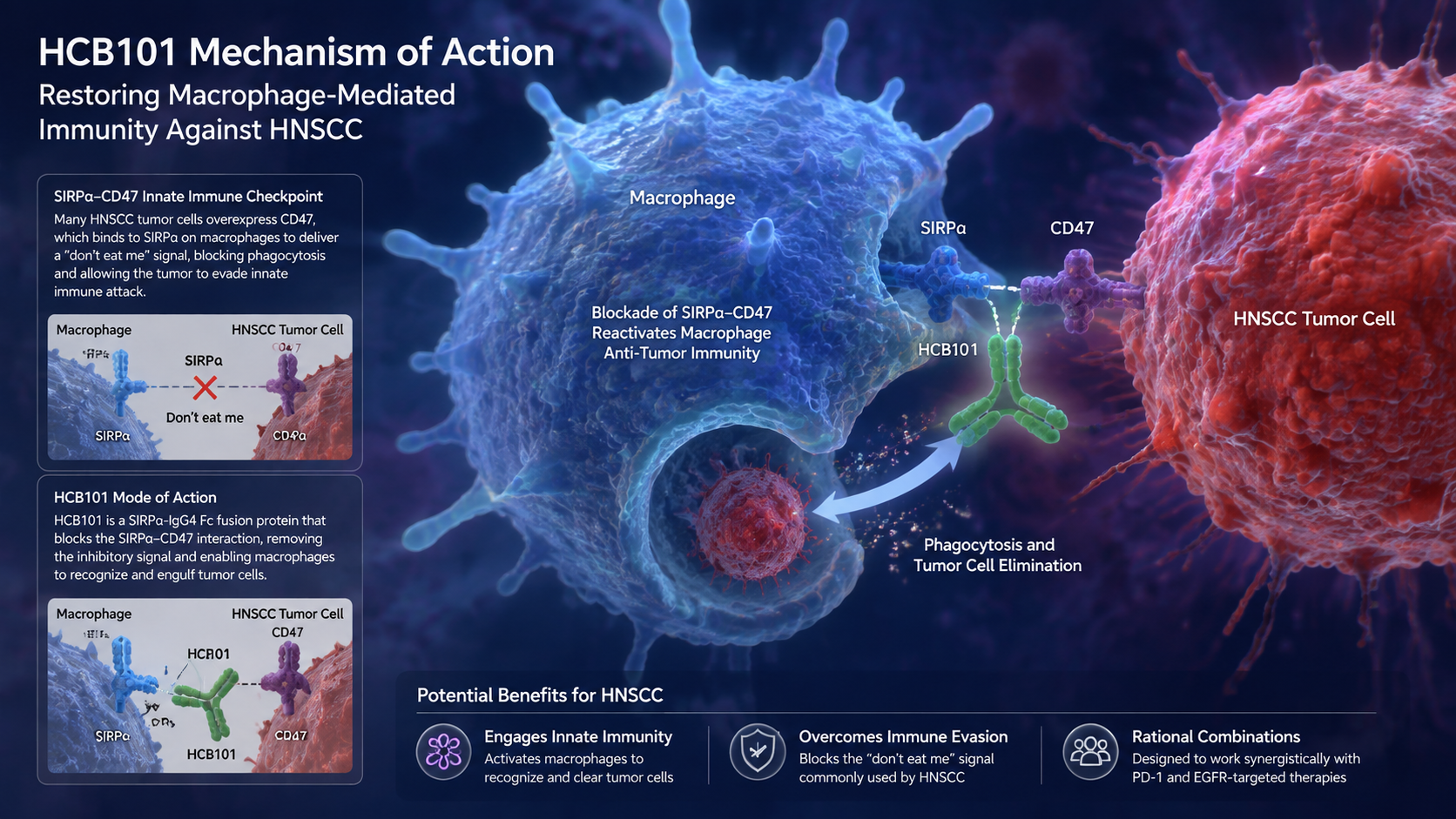
In first-in-human clinical testing, HCB101 has demonstrated dose-proportional pharmacokinetics and sustained CD47 receptor occupancy, including greater than 90% receptor occupancy at clinically relevant dose levels.
These pharmacologic findings have been accompanied by early clinical activity in HNSCC:
- Durable monotherapy activity: In Phase 1a dose escalation, an HNSCC patient treated with HCB101 monotherapy achieved a confirmed partial response with approximately 42% tumor reduction and remained on treatment for more than 80 weeks at the updated data cutoff.
- Supportive investigator-initiated clinical observations: In a low-dose (1.28 mg/kg) HNSCC cohort from an investigator-initiated study, 4 response-evaluable HNSCC patients demonstrated a 50% confirmed objective response rate (2/4) and 100% disease control at first assessment (4/4). Tumor reduction reached up to 68%, including one response that deepened from a partial response to a complete response.
The investigator-initiated dataset is small and preliminary and should be interpreted cautiously. Together with the durable monotherapy response, however, these observations provided important clinical support for prospective evaluation of HCB101 in HNSCC within the global HCB101-201 study.
“What makes today’s milestone important is not simply the first patient dosed, but the sequence of evidence that brought us here,” said Alvin Luk, Ph.D., M.B.A., C.C.R.A., President and Chief Medical Officer (Group) and CEO (U.S.A.) of HanchorBio. “We engineered HCB101 to address limitations that have challenged the CD47/SIRPα field, demonstrated sustained target engagement in patients, observed durable monotherapy activity in HNSCC, and then saw encouraging supportive activity from the Taiwan IIT. We are now taking that biological hypothesis into prospective global testing.”
Triple-Mechanism Strategy in HNSCC
Recurrent or metastatic HNSCC remains an area of substantial unmet medical need despite advances with PD-1-based therapy. The tumor microenvironment in HNSCC involves complex interactions among tumor cells, macrophages, myeloid populations, and adaptive immune cells that may contribute to immune resistance.
Cohort 6b evaluates a rational combination designed to engage complementary components of antitumor immunity:
- HCB101: Blocks the SIRPα-CD47 innate immune checkpoint to enhance macrophage-mediated antitumor activity.
- Pembrolizumab: Targets the PD-1 adaptive immune checkpoint to restore T-cell activity.
- Cetuximab: Targets EGFR-expressing tumor cells while providing an antibody-based backbone capable of engaging innate immune effector mechanisms.
“Cancer immunotherapy has been shaped largely by T-cell biology. We believe macrophages represent another important layer of antitumor immunity. By combining macrophage-directed innate immunity with PD-1 and EGFR-directed therapy, Cohort 6b allows us to test whether engaging multiple dimensions of immunity can improve outcomes in HNSCC, where substantial unmet need remains,” said Dr. Luk.
From Investigator-Generated Insight to Global Development
The HCB101 HNSCC program represents the progression of an investigator-generated clinical observation into prospective global development. Early clinical observations from the investigator-initiated study helped support HanchorBio’s decision to advance HCB101 into dedicated global HNSCC combination cohorts.
This progression highlights how clinical investigators can contribute not only to the execution of global trials, but also to the scientific and clinical insights that shape global drug development strategies.
“The value of early clinical research is not only the data it generates, but the scientific questions it allows us to ask next,” said the principal investigator. “The clinical activity observed in our HNSCC study encouraged us to further investigate macrophage-directed treatment in this disease. We are pleased that patients are now contributing directly to the global clinical evaluation of this strategy.”
Expanding the HCB101 Development Strategy
HCB101-201 is a global, multicenter, open-label Phase 1b/2a study evaluating HCB101 in rational combinations across prioritized solid tumors. In addition to HNSCC, HanchorBio is evaluating HCB101-based combinations in gastric cancer, colorectal cancer, and triple-negative breast cancer.
The HNSCC program expands HCB101 development beyond gastrointestinal malignancies and tests whether its therapeutic biology can translate into additional myeloid-rich and immunotherapy-relevant tumor settings.
“A platform is not validated because it can generate many molecules. It is validated when a biological idea repeatedly generates clinically meaningful hypotheses that can be tested across diseases, mechanisms and combinations,” Dr. Liu added. “HCB101 is our clinical anchor. What we are building around it is a broader understanding of how macrophage biology can become part of the next generation of cancer immunotherapy.”
About HCB101
HCB101 is an investigational engineered SIRPα–IgG4 Fc fusion protein developed using HanchorBio’s proprietary FBDB™ platform. HCB101 blocks CD47–SIRPα signaling and is designed to enhance macrophage-mediated antitumor immunity. It is being evaluated as monotherapy (NCT05892718) and in combinations (NCT06771622) across solid and hematologic malignancies. HCB101 has received U.S. FDA Orphan Drug Designation for gastric cancer.
About HanchorBio
Based in Taipei, Shanghai, and the San Francisco Bay Area, HanchorBio (TWSE: 7827) is a global clinical-stage biotechnology company focused on immuno-oncology and immune-mediated diseases. The Company’s proprietary Fc-based designer biologics (FBDB™) platform enables the engineering of multifunctional biologics with diverse targeting modalities designed to activate innate and adaptive immune pathways and address limitations of current immunotherapies.
HanchorBio is advancing a portfolio of innovative biologics designed to address significant unmet medical needs through differentiated molecular configurations, translational development strategies, and scalable CMC capabilities. For more information, please visit: https://www.HanchorBio.com
Reimagining Immunotherapy for Patients Worldwide.
Forward-Looking Statements
This press release contains forward-looking statements, including statements regarding the clinical development of HCB101; the design, conduct, timing, and potential outcomes of the HCB101-201 study and its HNSCC cohorts; the potential therapeutic characteristics and mechanisms of action, and combination strategies of HCB101; the potential role of macrophage-directed immunotherapy in HNSCC and other tumor settings; the development of HanchorBio’s pipeline; and the capabilities and potential of the FBDB™ platform. These statements are based on HanchorBio’s current expectations and assumptions and involve risks and uncertainties that could cause actual results to differ materially from those described. Early clinical and investigator-initiated study data may not be predictive of results from larger or later-stage clinical studies. There can be no assurance that ongoing or planned clinical studies will proceed as expected or that HCB101 will demonstrate safety, efficacy, or obtain regulatory approval. HanchorBio undertakes no obligation to update forward-looking statements except as required by applicable law.