



HanchorBio Partners with InSilicoTrials to Advance AI-Driven Clinical Development for HCB101
Collaboration will evaluate AI-enabled digital twins and external-control approaches that could reduce reliance on randomized control groups, accelerate clinical development, and improve capital efficiency
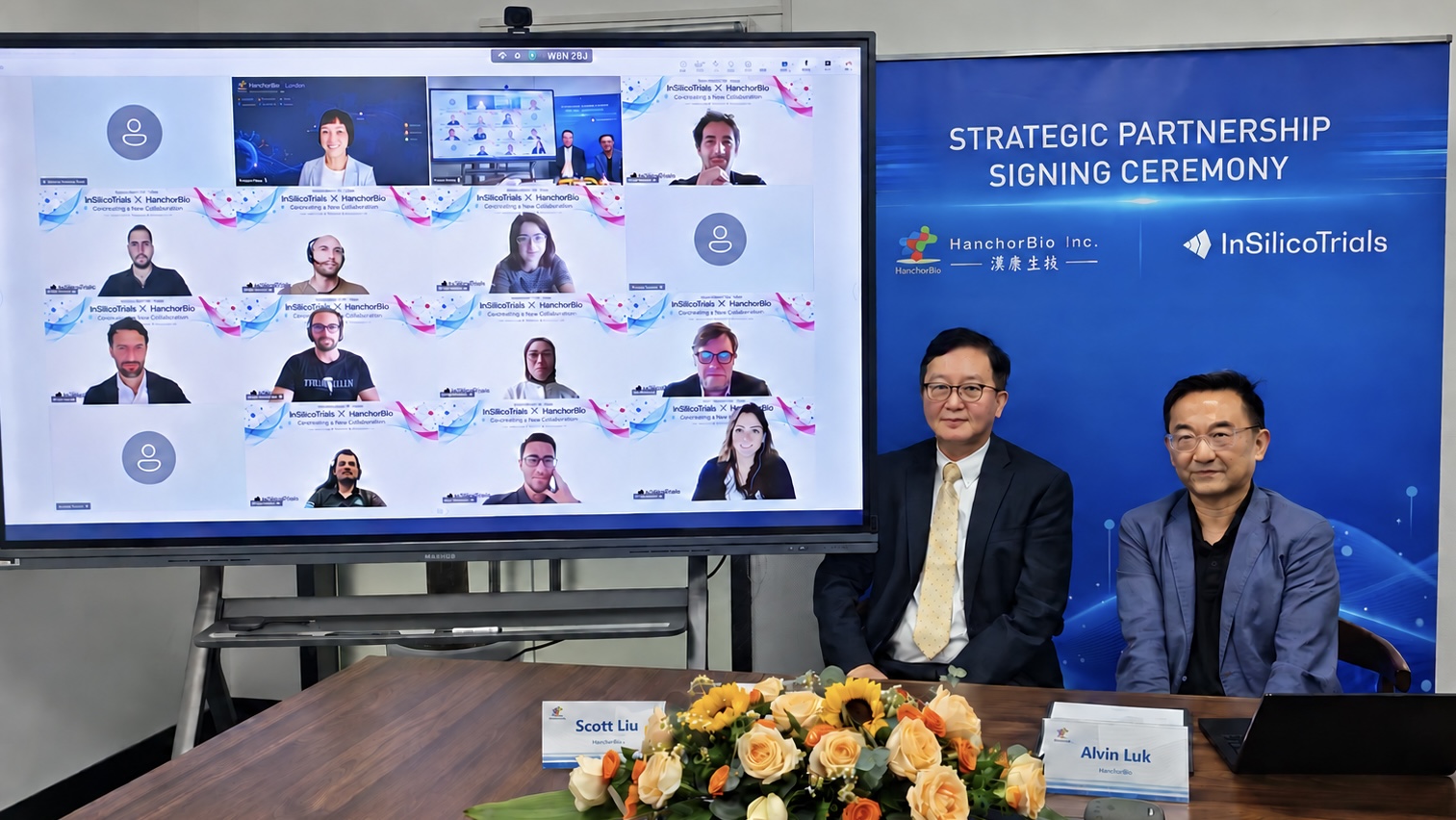
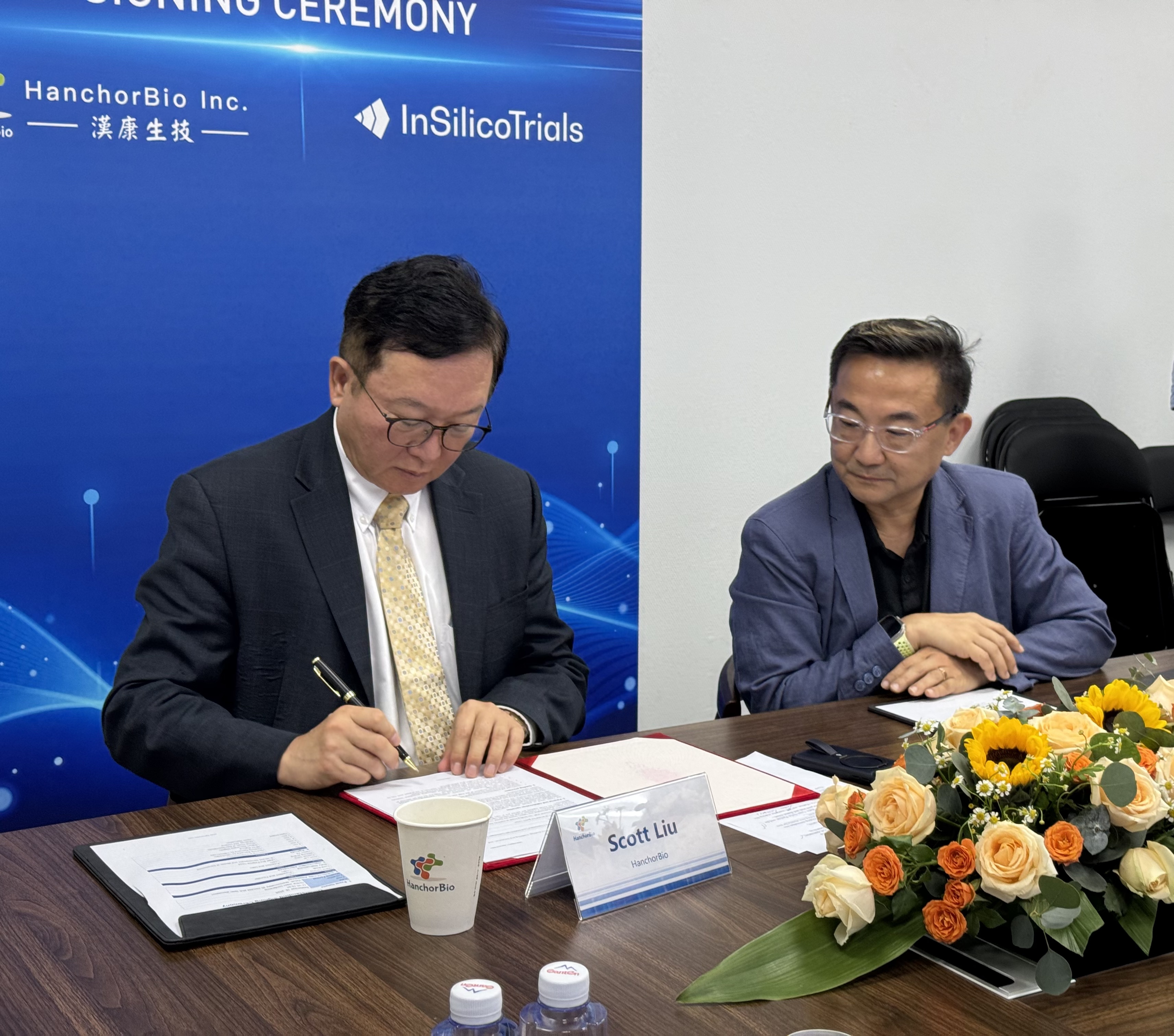
TAIPEI, SHANGHAI, and SAN FRANCISCO — September 16, 2026 — HanchorBio, Inc. (TWSE: 7827), a global clinical-stage biotechnology company developing next-generation immunotherapies for oncology and immune-mediated diseases, today announced that it has entered into a strategic memorandum of understanding (MOU) and an initial statement of work with InSilicoTrials Technologies S.p.A.
The collaboration with InSilicoTrials will evaluate whether advanced modeling, virtual patient populations—including digital twins—and external or hybrid control approaches can reduce the number of patients required in conventional randomized control groups in future HCB101 trials and, where scientifically justified and accepted by regulators, enable portions of conventional control-arm evidence to be generated through external or simulated approaches.
The potential impact is significant for both patients and HanchorBio. Fewer patients may need to be randomized to a control group, while more efficient trial designs could shorten enrollment timelines, reduce clinical-development costs and capital requirements, and accelerate the generation of evidence needed to advance HCB101 toward registration.
Under the initial statement of work, the companies will launch a regulatory and feasibility phase focused on HCB101 in second-line gastric/gastroesophageal junction (GC/GEJ) cancer. InSilicoTrials will integrate HanchorBio-generated clinical-trial data with relevant literature, real-world and standard-of-care data to model dose, exposure, safety, efficacy, and patient-variability scenarios.
The resulting simulations are intended to support dose selection, Phase 2/3 trial-design decisions, and the evaluation of external, hybrid, or augmented control approaches. Rather than automatically enrolling every comparator patient prospectively, these approaches may allow appropriately matched external or simulated patients to contribute part of the control evidence required for a clinical trial.
If successfully validated and accepted by health authorities, such approaches could potentially:
- reduce the number of patients randomized to conventional control treatment;
- shorten trial enrollment and development timelines;
- reduce the size and cost of pivotal clinical trials;
- improve probability-of-success assessment by evaluating multiple trial scenarios before large-scale investment decisions;
- improve capital efficiency by testing trial scenarios before committing to large studies; and
- increase the amount of clinically useful evidence generated from each enrolled patient.

“For us, the value of AI is very practical,” said Scott Liu, PhD, Founder and Chairman of HanchorBio. “If we can use scientifically rigorous modeling to reduce the number of patients who need to be randomized to a conventional control group, that has enormous potential value. For patients, it may mean fewer people needing to enter a trial knowing they may not receive the investigational treatment. For HanchorBio, it could mean faster enrollment, lower development costs, more efficient use of capital and ultimately a faster path toward bringing HCB101 to patients. That is the kind of AI application that matters to us.”
The companies will first evaluate the feasibility of such approaches and seek relevant regulatory feedback. No external or virtual control approach is presumed accepted in advance, and its eventual use would depend on data quality, methodological validity, the specific trial design, and feedback from regulatory authorities.
“We are excited to partner with HanchorBio to advance its promising HCB101 program through cutting-edge technology, AI, and rigorous modeling,” said Mario Torchia, Chief Executive Officer of InSilicoTrials. “This collaboration brings together clinical-trial simulation, virtual populations, real-world evidence, and regulatory planning around clearly defined development goals. Our ultimate goal is to bring safe and effective drugs to patients faster by applying innovation, AI, and rigorous modeling approaches to de-risk and accelerate drug development.”
Taking AI Beyond Drug Discovery
HanchorBio has already applied computational approaches across molecular design and development. The collaboration with InSilicoTrials extends those capabilities into an area that accounts for a substantial proportion of the time and capital required to develop new medicines: clinical trials themselves.
“AI in biotechnology is often discussed in terms of discovering molecules faster. We believe its impact can extend much further,” said Alvin Luk, PhD, MBA, CCRA, President and Chief Medical Officer (Group) and CEO (USA) of HanchorBio. “Clinical development is where enormous amounts of patient time and capital are committed. If modeling can help us select the right dose, test trial assumptions before enrollment begins, and ultimately reduce the number of patients required in conventional control groups, then AI can directly improve both the economics of drug development and the experience of patients participating in clinical trials.”
The collaboration is HanchorBio’s second publicly disclosed AI-enabled initiative, following the Company’s adoption of Bloomberg Intelligence to strengthen competitive, market and business-development analysis. The Company is also evaluating additional technologies in toxicology modeling, clinical-trial planning, patient selection, translational research and regulatory evidence generation.
The strategic MOU provides a framework to evaluate broader collaboration across additional HCB101 indications and, subject to future agreements, other HanchorBio pipeline programs, including HCB301 and HCB303.
HanchorBio management expects to discuss the collaboration and the Company’s broader AI-enabled drug-development initiatives during its previously announced participation in the inaugural Jefferies APAC Healthcare Conference in Shanghai on September 20–21, 2026.
About HanchorBio
HanchorBio (TWSE: 7827) is a global clinical-stage biotechnology company focused on inventing next-generation biologics for cancer and immune-mediated diseases using its proprietary FBDB™ platform. HanchorBio’s pipeline includes clinical-stage programs HCB101 and HCB301, next-generation trispecific program HCB303, and additional candidates across oncology and immunology. For more information, please visit http://hanchorBio.com
About InSilicoTrials
InSilicoTrials Technologies S.p.A. is a technology company applying artificial intelligence, modeling, and simulation to accelerate and de-risk drug development. Its AI Platform gives pharmaceutical and biotechnology teams access to validated computational models, virtual patient populations, synthetic-control methodologies, and clinical-trial simulation capabilities spanning discovery, preclinical development, clinical development, and CMC. By embedding advanced AI and computational evidence into development and regulatory decision-making, InSilicoTrials helps pharma partners bring safe and effective therapies to patients faster. For more information, please visit www.insilicotrials.com.
Selected Scientific and Regulatory References
- S. Food and Drug Administration. Considerations for the Use of Artificial Intelligence to Support Regulatory Decision-Making for Drug and Biological Products: Draft Guidance. January 2025. https://www.fda.gov/media/184830/download
- International Council for Harmonisation. ICH M15: General Principles for Model-Informed Drug Development. Final Guideline, January 2026; FDA Guidance for Industry, June 2026. https://www.fda.gov/regulatory-information/search-fda-guidance-documents/m15-general-principles-model-informed-drug-development
- S. Food and Drug Administration. Considerations for the Design and Conduct of Externally Controlled Trials for Drug and Biological Products: Draft Guidance. February 2023. https://www.fda.gov/regulatory-information/search-fda-guidance-documents/considerations-design-and-conduct-externally-controlled-trials-drug-and-biological-products
- Jumper J, Evans R, Pritzel A, et al. Highly accurate protein structure prediction with AlphaFold. 2021; 596:583–589. doi:10.1038/s41586-021-03819-2. https://doi.org/10.1038/s41586-021-03819-2
- HanchorBio Presents Two ASCO 2026 Abstracts Highlighting HCB101 Combination Activity and HCB301 First-in-Human Clinical Progress. June 1, 2026. https://www.hanchorbio.com/news/hanchorbio-presents-two-asco-2026-abstracts-highlighting-hcb101-combination-activity-and-hcb301-first-in-human-clinical-progress/
Note: These references provide general scientific, regulatory, and program context. They do not indicate that FDA or another health authority has reviewed, endorsed, or accepted any specific modeling, simulation, external-control, or hybrid-control methodology for HCB101.
Forward-Looking Statements
This press release contains forward-looking statements, including statements concerning the contemplated collaboration, potential uses of modeling and simulation, external or hybrid controls, real-world data, future regulatory interactions, potential co-development activities, and the development of HCB101 and other product candidates. These statements are based on current expectations and are subject to risks and uncertainties that could cause actual results to differ materially. The execution of the MOU does not guarantee that any subsequent workstream, regulatory submission, development strategy, co-development arrangement or transaction will be undertaken or completed. Except as required by applicable law, HanchorBio undertakes no obligation to update these statements.
HanchorBio Business Development Contact:
Email: [email protected]
Investor & Media Contact:
Email: [email protected]
漢康生技攜手 InSilicoTrials 推進 HCB101 AI 驅動臨床開發
雙方將評估運用 AI 數位分身與外部對照等方法,降低臨床試驗對隨機對照組的依賴,加速臨床開發並提升資本運用效率
【台北、上海、舊金山,2026 年 9 月 16 日】-全球臨床階段生技公司漢康生技(TWSE:7827)今日宣布,已與 InSilicoTrials Technologies S.p.A. 簽署策略合作備忘錄(MOU)及首份工作說明書(Statement of Work),共同探索運用人工智慧(AI)、建模與模擬技術推進 HCB101 臨床開發。
此次合作將評估先進建模、虛擬病人族群——包括數位分身(digital twins)——以及外部或混合對照(external or hybrid control)等方法,是否可於未來 HCB101 臨床試驗中減少傳統隨機對照組所需納入的病人人數;在具備充分科學依據並獲主管機關接受的情況下,亦將評估是否可透過外部資料或模擬方式,產生部分傳統對照組所需的證據。
此方法對病人與漢康生技皆具有重要的潛在價值。透過減少被隨機分派至對照組的病人人數,更有效率的臨床試驗設計有機會縮短收案時程、降低臨床開發成本與資金需求,並加速產生推進 HCB101 朝藥證申請所需的臨床證據。
根據首份工作說明書,雙方將首先針對 HCB101 用於二線胃癌/胃食道交界處癌(GC/GEJ)展開法規與可行性評估。InSilicoTrials 將整合漢康生技產生的臨床試驗數據,以及相關文獻、真實世界資料與現行標準治療數據,針對劑量、藥物暴露、安全性、臨床活性及病人差異等情境進行建模與模擬。
相關模擬結果預期將用於支持劑量選擇、第二/三期臨床試驗設計決策,以及外部、混合或增強型對照(augmented control)方法的評估。相較於所有對照組病人皆須以前瞻方式納入臨床試驗,此類方法可能允許經適當配對的外部或模擬病人,提供臨床試驗所需的部分對照證據。
若相關方法成功獲得驗證並獲主管機關接受,未來可能:
- 減少被隨機分派接受傳統對照治療的病人人數;
- 縮短臨床試驗收案及開發時程;
- 降低關鍵性臨床試驗的規模與成本;
- 在進行大規模投資決策前,透過評估多種臨床試驗情境,提升對開發成功機率的評估;
- 在投入大型臨床試驗前先測試不同試驗情境,以提升資本運用效率;
- 提高每位受試者所能產生的臨床有效資訊量。
漢康生技創辦人暨董事長劉世高博士表示:「對我們而言,AI 的價值非常實際。如果我們能透過科學嚴謹的建模方式,減少必須被隨機分派至傳統對照組的病人人數,將具有相當大的潛在價值。對病人而言,這可能意味著更少的人需要在明知可能無法接受試驗藥物的情況下參與臨床試驗;對漢康而言,則可能代表更快的收案速度、更低的開發成本、更有效率的資本運用,最終加速將 HCB101 帶給病人。這正是我們重視的 AI 應用。」
雙方將首先評估此類方法的可行性,並尋求相關主管機關意見。目前並未預設任何外部或虛擬對照方法已獲主管機關接受,未來是否實際採用,仍將取決於資料品質、方法學有效性、特定臨床試驗設計,以及主管機關的意見。
InSilicoTrials 執行長 Mario Torchia 表示:「我們很高興能與漢康生技合作,透過尖端技術、AI 與嚴謹的建模方式,推進具潛力的 HCB101 開發計畫。此次合作將臨床試驗模擬、虛擬病人族群、真實世界證據與法規規劃整合於明確的開發目標之下。我們最終的目標,是透過創新、AI 與嚴謹的建模方法降低藥物開發風險並加速開發,讓安全且有效的藥物更快提供給病人。」
將 AI 應用從新藥探索延伸至臨床開發
漢康生技已將運算方法應用於分子設計與藥物開發流程。此次與 InSilicoTrials 的合作,進一步將相關能力延伸至新藥開發中高度耗費時間與資本的重要環節——臨床試驗本身。
漢康生技總裁暨集團醫療長、美國漢康執行長陸英明博士表示:「生技產業談到 AI 時,經常聚焦於如何更快發現新分子,但我們相信,AI 的影響可以延伸得更遠。臨床開發需要投入大量病人的時間與資本。如果建模能協助我們選擇適當劑量、在收案開始前測試臨床試驗假設,並最終減少傳統對照組所需的病人人數,AI 就能直接改善新藥開發的經濟效率,以及病人參與臨床試驗的整體體驗。」
此次合作為漢康生技第二項已公開揭露的 AI 賦能計畫。在此之前,公司已導入彭博,以強化競爭、市場及商業開發分析能力。公司目前亦持續評估其他技術在毒理建模、臨床試驗規劃、病人篩選、轉譯研究及法規證據產出等領域的應用。
此次策略合作備忘錄亦建立雙方未來擴大合作的框架,可進一步評估 HCB101 其他適應症;若後續另行達成協議,合作亦可能延伸至漢康生技其他產品線,包括 HCB301 與 HCB303。
漢康生技管理團隊預計亦將於先前已宣布參與、2026 年 9 月 20 至 21 日於上海舉行的首屆 Jefferies 亞太醫療保健大會(Jefferies APAC Healthcare Conference)中,進一步分享此次合作,以及公司更廣泛的 AI 賦能新藥開發布局。
關於漢康生技
漢康生技(HanchorBio,TWSE:7827)是一家全球臨床階段生技公司,專注運用自主開發的 FBDB™ 平台,開發用於癌症與免疫介導疾病的下一代生物藥。
透過作用於先天性與適應性免疫路徑,漢康生技開發具差異化的生物藥,以克服腫瘤及免疫介導疾病中的治療抗性。公司產品線包括臨床階段候選藥物 HCB101 與 HCB301、下一代三特異性候選藥物 HCB303,以及其他涵蓋腫瘤與免疫疾病領域的研發項目。
關於 InSilicoTrials
InSilicoTrials Technologies S.p.A. 是一家運用人工智慧、建模與模擬技術,加速藥物開發並降低開發風險的科技公司。
其 AI 平台為製藥及生技團隊提供經驗證的運算模型、虛擬病人族群、合成對照方法及臨床試驗模擬能力,涵蓋藥物發現、臨床前開發、臨床開發及 CMC 等階段。透過將先進 AI 與運算證據整合至開發及法規決策流程,InSilicoTrials 協助製藥合作夥伴更快將安全且有效的治療帶給病人。
前瞻性聲明
本新聞稿包含前瞻性聲明,包括與本次規劃合作、建模與模擬的潛在應用、外部或混合對照、真實世界資料、未來法規互動、潛在共同開發活動,以及 HCB101 與其他候選產品開發相關之陳述。
上述聲明係基於目前預期,並受到相關風險與不確定因素影響,實際結果可能與前瞻性聲明所述內容存在重大差異。本次簽署合作備忘錄並不保證任何後續工作項目、法規申請、開發策略、共同開發安排或交易將實際展開或完成。除適用法律另有要求外,漢康生技不承擔更新上述聲明之義務。