



HanchorBio Showcases HCB101 Myeloid-Enhancer Strategy in Gastric Cancer and HNSCC at JCA-AACR 2026
Poster presentations highlight HCB101’s differentiated SIRPα-Fc strategy across upper digestive and head and neck cancers
[Taipei, Shanghai, San Francisco | June 30, 2026] – HanchorBio, Inc. (TWSE : 7827), a global clinical-stage biotechnology company advancing next-generation immunotherapies for oncology and autoimmune diseases, today announced poster presentations of HCB101 clinical data at the 9th Japanese Cancer Association (JCA) and the American Association for Cancer Research (AACR) Special Joint Conference on Novel Therapies and Diagnostics in Upper Digestive and Head and Neck Cancers, taking place June 28-30, 2026, in Kyoto, Japan.
HCB101 is HanchorBio’s differentiated engineered SIRPα-IgG4 fusion protein designed to selectively block CD47–SIRPα “don’t eat me” signaling while reducing red-blood-cell binding. By restoring macrophage-mediated tumor-cell phagocytosis and supporting antigen presentation, HCB101 is being developed as a myeloid-enhancing immune backbone for rational combination therapy, with second-line gastric/gastroesophageal junction cancer as the lead clinical development focus. This strategy is particularly relevant in upper digestive and head and neck cancers, where myeloid-rich tumor microenvironments, impaired antigen presentation, immune exclusion, and treatment resistance continue to limit durable benefit.
“HCB101 is the clinical anchor of HanchorBio’s myeloid enhancer platform and our first major validation point for SIRPα-backbone biology,” said Scott Liu, PhD, Founder, Chairman, and CEO of HanchorBio. “Our strategy begins with second-line gastric cancer as the lead clinical anchor, then extends into first-line gastric cancer, HNSCC, colorectal cancer, and other selected solid tumors where myeloid biology and the tumor microenvironment play important roles. Over time, we believe this platform can expand from CD47–SIRPα biology into broader multi-axis myeloid tumor microenvironment modulation, and potentially beyond oncology into autoimmune, cardiovascular, and CNS diseases.”
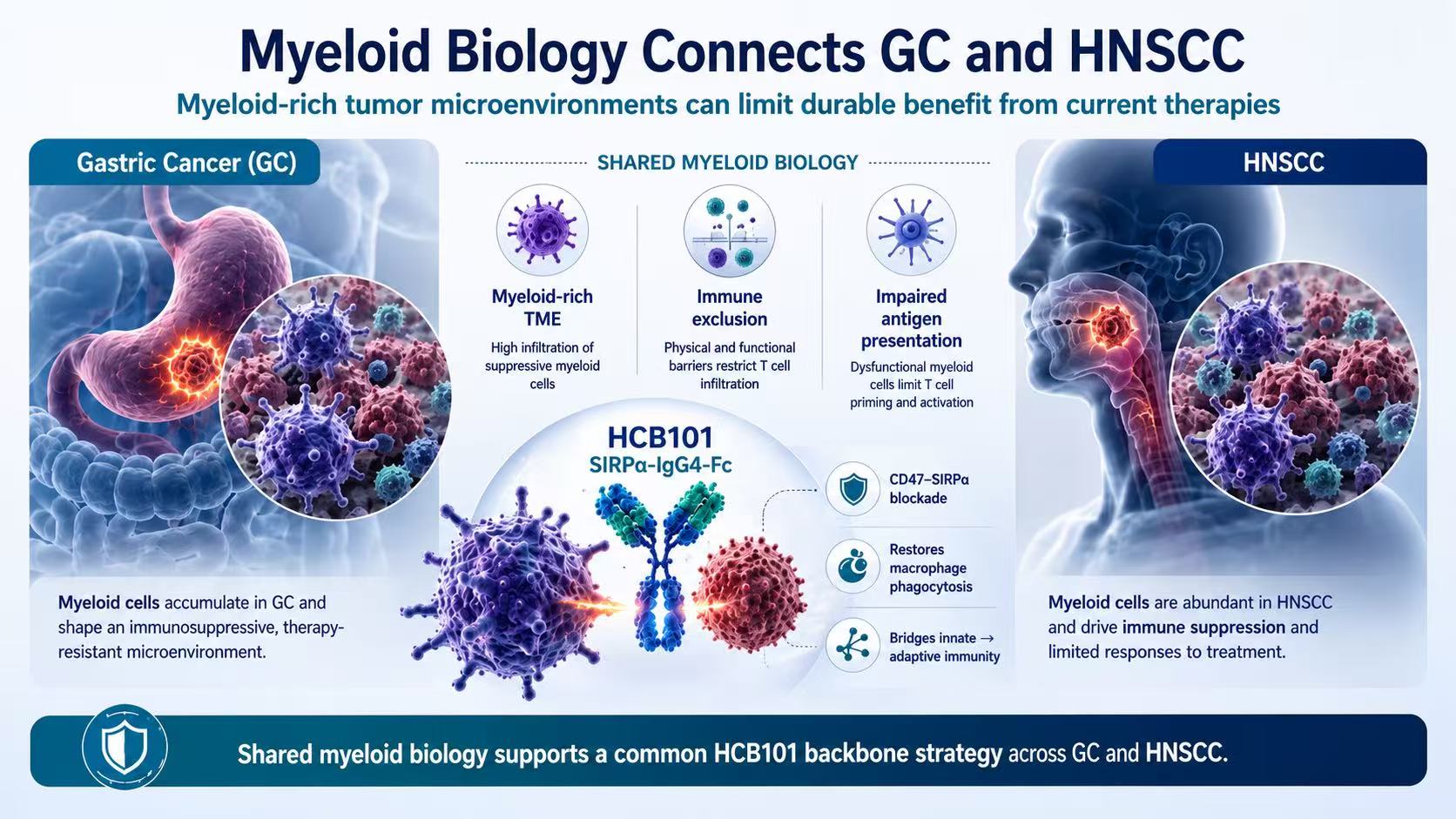
Gastric Cancer: Lead Clinical Anchor for HCB101
In gastric cancer, HCB101 was evaluated in the ongoing Phase 1b/2a HCB101-201 study (NCT06771622) in combination with standard-of-care regimens. In second-line gastric/gastroesophageal junction (GEJ) cancer, HCB101 plus ramucirumab and paclitaxel demonstrated encouraging preliminary antitumor activity, with the most mature signal observed in the 5.12–8 mg/kg mid-dose cohorts. Across 15 efficacy-evaluable patients, dose-related antitumor activity was observed, including an 80% objective response rate in the mid-dose cohorts and a disease control rate of 93.3% across the overall cohort. The regimen showed a manageable safety profile, with no unexpected overlapping toxicities observed.
The gastric cancer poster also included preliminary data from first-line HER2-positive gastric/GEJ cancer, where HCB101 was combined with trastuzumab, pertuzumab, and CAPEOX. This regimen highlights an important aspect of HCB101’s combination strategy: CD47–SIRPα blockade may be most effective when paired with functional macrophage engagement. Trastuzumab and pertuzumab provide HER2-directed, Fc-active tumor targeting, while HCB101 is designed to restore macrophage-mediated phagocytosis of tumor cells. In this setting, HCB101-based combination therapy demonstrated preliminary activity, including a 75% objective response rate and 100% disease control rate across the overall cohort.
“HCB101’s second-line GC data are important because this is a clinically defined setting with an established standard-of-care comparator, interpretable endpoints, and a clear potential registrational pathway,” said Alvin Luk, PhD, MBA, CCRA, President & Chief Medical Officer (Group) and CEO (U.S.A.) of HanchorBio. “Our priority is to convert the current 2L GC signal into a disciplined development path, including dose and schedule optimization, regulatory alignment, and a randomized strategy that can support future registration. From this anchor, we can extend HCB101 into broader GI cancers and selected solid tumors where anti-VEGF, EGFR, HER2, chemotherapy, and immuno-oncology combinations provide rational settings for myeloid-enhanced tumor clearance.”
HNSCC: Encouraging Expansion Signal in a Myeloid-Rich Tumor Setting
In head and neck squamous cell carcinoma, HCB101 data were presented across monotherapy and combination settings. In the ongoing Phase 1a HCB101-101 monotherapy study (NCT05892718), HCB101 demonstrated a clinically manageable safety profile and preliminary activity, including a confirmed partial response in a patient with HNSCC (ongoing >72 weeks) and durable stable disease in additional HNSCC and nasopharyngeal carcinoma patients.
The HNSCC poster also included early data from a Taiwan investigator-initiated combination study (NCT07136545) of HCB101 with pembrolizumab in recurrent/metastatic HNSCC. Among the three PD-1–naïve patients treated at 1.28 mg/kg, early tumor regression was observed, including one complete response, one partial response, and one stable disease. These early findings require prospective confirmation, but support continued evaluation of HCB101 in HNSCC, including rational combinations with pembrolizumab and cetuximab.
HanchorBio plans to continue advancing HCB101 in gastric cancer, HNSCC, and other selected solid tumors where CD47–SIRPα biology, macrophage-mediated immunity, and rational standard-of-care combinations may support meaningful clinical benefit.
Poster Presentation Details
Title: HCB101 SIRPα-Fc fusion protein in gastric cancer: clinical activity in second-line and first-line combination settings
Session: Poster Presentation
Location: Kyoto Tokyu Hotel
Date/Time: June 29, 2026 (16:45 to 17:45 JST)
Title: Preliminary clinical activity of HCB101, a SIRPα-Fc fusion protein, in HNSCC across monotherapy and combination settings
Session: Poster Presentation
Location: Kyoto Tokyu Hotel
Date/Time: June 29, 2026 (16:45 to 17:45 JST)
About HanchorBio
Based in Taipei, Shanghai, and the San Francisco Bay Area, HanchorBio (TWSE : 7827) is a global clinical-stage biotechnology company focused on immuno-oncology and immune-mediated diseases. The company is led by an experienced team with a proven track record in biologics discovery and global development, aiming to reshape the landscape of cancer therapies. HanchorBio’s proprietary Fc-based designer biologics (FBDB™) platform enables the design of multi-functional biologics with diverse targeting modalities, designed to activate both innate and adaptive immune pathways and overcome the current challenges of anti-PD1/L1 immunotherapies. The FBDB™ platform has delivered proof-of-concept data in several in vivo tumor animal models. HanchorBio is advancing a portfolio of innovative biologics designed to address significant unmet medical needs through differentiated molecular configurations in R&D and scalable CMC strategies.
Forward-Looking Statements
This press release contains forward-looking statements regarding HanchorBio’s clinical development programs, product candidates, regulatory strategy, and future plans. Actual results may differ materially from those expressed or implied due to various risks and uncertainties, including clinical development outcomes, regulatory decisions, and market conditions. HanchorBio undertakes no obligation to update forward-looking statements except as required by applicable law.
漢康生技於 JCA-AACR 2026 發表 HCB101 髓系免疫增強策略,聚焦胃癌與頭頸癌
HCB101 於上消化道癌及頭頸癌的臨床數據與差異化開發策略
【台北、上海、舊金山|2026 年 6 月 30日】漢康生技(TPEx:7827)為一家致力於開發次世代免疫療法、聚焦腫瘤與自體免疫疾病的全球臨床階段生技公司,今日宣布於在第九屆日本癌症學會(JCA)與美國癌症研究協會(AACR)上消化道與頭頸癌新型療法及診斷特別聯合會議中,以壁報形式發表 HCB101 於胃癌及頭頸部鱗狀細胞癌之臨床數據。本次會議於 2026 年 6 月 28 日至 30 日在日本京都舉行。
HCB101 為漢康生技自主開發的工程化 SIRPα-IgG4 融合蛋白。許多腫瘤細胞會透過 CD47–SIRPα 訊號向免疫系統傳遞「不要吃我」的訊息,使巨噬細胞難以發揮清除腫瘤的功能。HCB101 的設計目標,是阻斷這個腫瘤逃避免疫攻擊的關鍵訊號,協助恢復巨噬細胞吞噬腫瘤細胞的能力;同時透過差異化的分子設計,降低與紅血球結合之風險。因此,HCB101 正被開發為可與現有標準治療及其他抗癌藥物聯合使用的免疫治療骨幹療法,並以二線胃癌/胃食道交界癌作為目前主要臨床開發核心。此策略對上消化道癌及頭頸癌尤其具有意義,因為這些癌別的腫瘤微環境通常較為複雜,免疫細胞功能容易受到抑制,也較容易出現治療抗藥性,限制現有療法帶來長期且穩定的臨床效益。
漢康生技創辦人、董事長暨執行長劉世高博士表示:「HCB101 是漢康生技臨床開發中的核心資產,也是我們驗證以巨噬細胞等髓系免疫細胞為核心之免疫增強策略的重要起點。我們目前以二線胃癌作為主要開發方向,並逐步拓展至一線胃癌、頭頸部鱗狀細胞癌、結直腸癌及其他腫瘤微環境較複雜、髓系免疫細胞參與程度較高的實體腫瘤。長期而言,我們相信,此一髓系免疫平台策略有機會從 CD47–SIRPα 機制出發,進一步延伸至更多腫瘤免疫調節路徑,並為未來拓展至自體免疫、心血管及中樞神經系統疾病等領域奠定基礎。」
胃癌:HCB101 主要臨床開發核心
在胃癌方面,HCB101 於進行中的 1b/2a 期 HCB101-201 試驗(NCT06771622)中,與標準治療方案進行聯合用藥評估。在二線胃癌/胃食道交界癌中,HCB101 聯合 ramucirumab(抗 VEGFR-2 單株抗體)及 paclitaxel(化療藥物)展現令人鼓舞的初步抗腫瘤活性,其中最成熟的療效訊號出現在 5.12–8 mg/kg 的中劑量組別。於 15 位可評估療效患者中,觀察到與劑量相關的抗腫瘤活性,包括中劑量組達 80% 的客觀緩解率(ORR),以及整體受試者達 93.3% 的疾病控制率(DCR)。該聯合治療方案整體安全性可控,且未觀察到非預期的毒性疊加。
胃癌的發表壁報亦納入一線 HER2 陽性胃癌/胃食道交界癌之初步數據,其中 HCB101 與 trastuzumab、pertuzumab (HER2 標靶單株抗體)及 CAPEOX 化療方案聯合使用。此治療組合凸顯 HCB101 聯合策略的重要面向:CD47–SIRPα 阻斷可能在搭配具功能性巨噬細胞參與的治療時發揮更大潛力。Trastuzumab 及 pertuzumab 可提供 HER2 導向且具 Fc 功能的腫瘤標靶作用,而 HCB101 則設計用於恢復巨噬細胞對腫瘤細胞的吞噬能力。在此治療情境下,HCB101 聯合療法展現初步臨床活性,包括整體受試者達 75% 的客觀緩解率及 100% 的疾病控制率。
漢康生技總裁暨集團醫療長、美國執行長陸英明博士表示:「HCB101 的二線胃癌數據具有重要意義,因為這是一個臨床定義明確、具既有標準治療對照、臨床終點可解讀,且具潛在註冊路徑的治療場域。我們的優先目標,是將目前二線胃癌所觀察到的訊號,轉化為嚴謹的臨床開發路徑,包括劑量與給藥時程優化、法規溝通,以及可支持未來註冊申請的隨機化試驗策略。以此為核心,我們可進一步將 HCB101 延伸至更廣泛的消化道癌及特定實體腫瘤,特別是在 anti-VEGF、EGFR、HER2、化療及免疫腫瘤治療等聯合策略可合理支持髓系免疫增強腫瘤清除作用的治療場域。」
頭頸部鱗狀細胞癌:HCB101 於髓系免疫活躍的腫瘤環境中展現初步臨床訊號
在頭頸部鱗狀細胞癌方面,本次發表涵蓋 HCB101 單藥及聯合治療的數據。於進行中的 1a 期 HCB101-101 單藥試驗(NCT05892718)中,HCB101 展現臨床可管理之安全性及初步活性,包括一位頭頸部鱗狀細胞癌患者達確認部分緩解(PR),且反應持續超過 72 週;此外,亦有其他頭頸部鱗狀細胞癌及鼻咽癌患者達持久疾病穩定(SD)。
頭頸癌壁報亦納入台灣研究者發起之 HCB101 聯合 pembrolizumab (PD-1 免疫檢查點抑制劑)用於復發/轉移性頭頸部鱗狀細胞癌之早期數據(NCT07136545)。在三位於 1.28 mg/kg 劑量接受治療且未曾使用 PD-1 治療的患者中,觀察到早期腫瘤縮小,包括一位完全緩解(CR)、一位部分緩解(PR)及一位疾病穩定(SD)。上述早期發現仍需前瞻性研究進一步確認,但支持 HCB101 持續於頭頸部鱗狀細胞癌中進行評估,包括與 pembrolizumab 及 cetuximab (EGFR 標靶單株抗體)等療法之聯合策略。
漢康生技計畫持續推進 HCB101 於胃癌、頭頸部鱗狀細胞癌及其他特定實體腫瘤之臨床開發,特別是在 CD47–SIRPα 生物學、巨噬細胞介導免疫,以及與標準治療之理性聯合策略可能支持具臨床意義療效的治療場域。
壁報發表資訊
題目: HCB101 SIRPα-Fc fusion protein in gastric cancer: clinical activity in second-line and first-line combination settings
形式: 壁報發表
地點: Kyoto Tokyu Hotel
日期/時間: 2026 年 6 月 29 日,16:45–17:45(日本標準時間,JST)
關於漢康-KY
英屬開曼群島商漢康生技股份有限公司(以下簡稱“漢康-KY”,股票代碼:7827)成立於2020年,由具豐富國際藥物開發與運營經驗的劉世高博士創辦。公司專注於腫瘤免疫藥物研發,透過自主建立的核心「FBDB多功能融合蛋白技術平台」開發出8+種創新蛋白生物藥,具有廣譜抗癌潛力,可抑制多種實體瘤及血液腫瘤,並持續取得多項專利。其中HCB101與HCB301已進入臨床試驗階段,而HCB101在2025年6月更完成首項國際授權,總授權金達2.02億美元。漢康-KY的策略是以多功能生物藥克服現行採取免疫療法與化療並行的高失敗率,同時藉由啟動先天性免疫和適應性免疫體系以摧毀腫瘤,致力提供高效且可負擔的新一代腫瘤免疫治療方案,解決未滿足的醫療需求。
聲明
本新聞稿及同時發佈之相關資訊內含有預測性敘述;其內容乃根據既有之風險及可能的不確定性進行判斷及預測,包括:市場因素與其他非漢康-KY(以下簡稱本公司)所能掌控之原因。這些預測性敘述是基於現況的預測和評估,除非基於法律的要求,本公司不負日後更新之責。